Monday, December 24, 2007

...upon seeing a bird on a car in a parking lot...

This afternoon, I saw a great-tailed grackle on the hood of a car in the Trader Joe's parking lot...

Whenever I see one, I am instantly transported back to living in Nicaragua, where, like clockwork at 5:30 a.m. and 5:30 p.m., the trees across the street would roar to life with the birds, waking and returning...

Quiscali mexicani are called zanates (sah-NAH-tehs) in Central America...

And so, it is a bird that has inspired me to post my first video-clip to a blog--taken when I was still learning to use my digital camera in Central America--zanates at sunset, León, Nicaragua, a year-and-a-half ago:

========================================================

Earlier in the afternoon, since we both had the day off work, my wife and I decided to go for a short hike--we drove to the eastern edge of the city--strip-malls peter out into ranches tucked into mesquite woods and finally you hit the boundary of national park wilderness-land...A perfect winter-in-the-desert-day: 69 degrees in the sun, after a frosty morning...The view below is taken from the Rincon foothills, looking to the NW, towards the Santa Catalinas and the Tucson mountains...


(Which version shows the textures of the 'teddy-bear' cholla cactus better--the black-and-white or the sepia? S. prefers the b&w...I like the 'old-west'-feel of the sepia...)

Further up the trail, you climb up a ridge that lets you see the snowy forested summit, 8000 feet up...

=====================================================

...and today's word-of-the-day, gleaned from this morning's local paper:

Guatemexicoestadounidenses

Huh? Here's the link to the article, if you're curious...

Friday, December 21, 2007

Angles of light...birdie woes...

Winter solstice in the northern hemisphere:

On December 21st,
Tucson's sunrise to sunset is 7:21 a.m. to 5:23 p.m.--

10 hours 2 minutes and 14 seconds of daytime,
with the sun at 34.4 degrees above the horizon.

Compare that to Seattle's 7:55 sunrise to 4:20 sunset--
just 8 hours 25 minutes of daytime(!),
with the sun at a measly 19.9 degrees above the horizon.

My childhood winters in northern Germany--8:33 sunrise and sunset at 4:22,
just 7 hrs 49 minutes of day,
with the sun barely peaking at 15 degrees above the southern horizon.

Angles of light are important--
artists speak of 'the special light in Provence'...

or 'the quality of light in Santa Fe'...
'the way the sun rains down in Tuscany' etc, etc...
it's all about geometry--

how many degrees up in the sky, how long are the shadows...

The numbers will make you crazy; they'll send you packing...

No wonder Van Gogh left the Low Countries for the South of France...

More statistics, for six months from now:
Summer solstice:
Tucson-5:18 sunrise to 7:34 sunset (standard time; AZ doesn't switch to daylight savings),
81.2 degrees in the sky, almost overhead; positively tropical.
Seattle-5:12 sunrise to 9:11 (daylight savings time), solar noon at 65.8 degrees above the horizon.

(Incidentally, here's a link to world night/day map:
http://www.timeanddate.com/worldclock/sunearth.html)

Nicaragua in December--the sun is at 54.5 degrees above the horizon...
maybe that's why León's colonial streets and its volcanic countryside looked more Tuscan in December...

Here in Tucson now--lovely morning shadows on the mountains; they really are purple on the horizons...
And just in time for winter, last week, and then again today, there has been snow on the Catalinas:


Yes, that's my work-window-view of the Catalinas, in mid-town Tucson...

...and from the entrance to Sabino Canyon, the Rincons on the east are snow-dusted as well:

This past weekend, my wife's parents were in town...so we drove up the Catalina highway; at about 7000 feet up, the icicles were impressive--there IS winter in southern Arizona; all is not cactus: ...and this is the view south, toward the Santa Rita mountains...there was snow all the way down to about 4500 feet, on the northern slopes...


...and we got down to the base of the mountains just in time for sunset: ========================

And now, for birdie woes.

Tango has been sick. Liver problems, evidently...leading to neurological issues, meaning falls and lack of equilibrium--birdie vertigo! Some trips to the vet ($$$), and now with medication and temporary cage-modifications, our Senegal parrot is improving.

I would never have guessed I would one day spend MONEY on a little birdie...(blood test? cholesterol levels?) but hey, when the little companion has a life-span of THIRTY years, you can't NOT help him out, right? (Truly, he is a feathered-friend.) A hamster or a gecko, I might just let go, you know, but a parrot?...well...It's been a dodgy few days for avian health in our household, but he's pulling through...and we can sleep more soundly...

Ay ay ay...

Winter in Tucson, then...freezing nights and snow-capped sunny afternoons, yards full of ripe citrus, an ailing parrot, and now, time off...

Tuesday, December 11, 2007

Lettuce on ice...cultural collision...

The first snows have arrived on the mountains around Tucson...
...down to around 6000 feet...
A thunderstorm hit yesterday afternoon down in the valley,
leaving a half-inch of ice pellets on the ground...and it was PINK!
Seriously...some wind updrafts must have picked up some desert sand somewhere, and it came down as pink hail in our little front yard...
Our little lettuce-garden got beat-up by the skyborn refrigeration;
the perils of winter gardening...


In today's International Herald Tribune, there's a very interesting opinion piece dealing with Arizona;
local issues on in an international stage...
Here's the link to the column:
=======================================
Where Mariachis and Minutemen collide
by Lawrence Downes
PHOENIX, Arizona

Want to see America unraveling? Come here, to Thomas Road and 35th Street, to M. D. Pruitt's furniture store. Come on Saturday morning and stand near the eight delivery trucks barricading the parking lot, like the wall of an urban Alamo.

For the last seven weeks, a sidewalk protest here by Latino immigrants has blossomed into a feverish reality show, attracting Minutemen, mariachis, children dancing in Mexican folk costume, white racists, United Nations observers, Phoenix police officers and Maricopa County sheriff's deputies.

The weekly confrontation - strident and stalemated - perfectly mimics the national debate. But it's a sideshow to something uglier: What happens when immigration's complexities are handed to local law enforcers sympathetic to the fury of one side.
Thomas Road has lots of Latino day laborers, or jornaleros, who hustle for work near Home Depot. A few months ago, the Phoenix police shooed them away. They dispersed to streets nearby, angering local businesses. One of the biggest, Pruitt's, hired off-duty city police officers to keep jornaleros at bay. The city put a stop to that, so Pruitt's turned to the county sheriff, Joe Arpaio.

Sheriff Joe, as he is known, needed no prodding: Hunting undocumented immigrants is his specialty. He has arrested hundreds under a state antismuggling law (for smuggling themselves) and has had 160 officers deputized as federal immigration agents. They have made more than 50 arrests near Pruitt's since the protests began.

They'll pull a car over for a traffic infraction, then check everyone's papers. They say they act on reasonable suspicion only - if they see a shirt or shoes like those worn south of the border or hear Spanish. They say it isn't profiling.

There is no doubt whose side Sheriff Joe is on. He has officers on Pruitt's payroll, guarding the lot on protest days. Last week, he issued a news release demanding that the demonstrators stop hurting Pruitt's and vowing to crank up the pressure until they went away. It was a naked attempt to stifle dissent and help a business ally.

People here are used to that from Sheriff Joe. He describes himself as "America's meanest sheriff" and has recently been basking in the love of nativists like the Minuteman Chris Simcox and radio host Terry Anderson, who gushed over him at a roast in Sun City West this month.

If Arizona begins punishing companies that hire illegal workers under a law that takes effect Jan. 1 - a lawsuit to block it was thrown out Friday - it will fall to counties to do the purge. In Maricopa, that means Sheriff Joe.

The protesters at Pruitt's are the only real opposition he has faced. Their leader is Salvador Reza, a stocky American of Mexican and Apache ancestry, an Air Force veteran who has spent years organizing jornaleros and small-business owners here.

Reza says he can't understand why America accepts global flows of companies, money and jobs but not workers. Why faith in market forces seems to have been eclipsed by fear of immigrants. Or why the country cannot set up legal channels to let jornaleros come and go and not be hassled.

"They actually are people with a work ethic that would make the Puritans proud," he said.

Pruitt's owner, Roger Sensing, says he needs armed officers to protect customers from jornaleros. Reza calls that ridiculous, and one informed noncombatant, the Reverend Craig Geiger, pastor of a Lutheran church across the street, agrees. He told me he had never seen a laborer enter Pruitt's lot. He also said his Latino congregation did not drive to church anymore. Documented or not, they fear Sheriff Joe. They walk.

Pastor Geiger leaves the neighborhood on Saturdays, because it gets deafening. When I was there, a trio singing Mexican ballads strolled through the crush. A Minuteman with a bullhorn followed them. "Monkeys coming through!" he shouted. His side rushed up to drown the music out: "Born in the U.S.A.! Born in the U.S.A.! KKK! Viva la Migra! January First!"

The restrictionists see Jan. 1 as the dawn of a new era, when the Mexicans disappear and everything gets pure and legal again. It is uncertain whether Arizona's economy will survive the exodus. "Unfortunately, they'll probably wake up when they bankrupt the state," Reza told me.

Lawrence Downes is a member of the New York Times editorial board.

Monday, November 26, 2007

First snow...

...no, not here in Tucson itself--but in mountains nearby.
About 2 hours to the east are the Pinaleño mountains, just north of the agricultural area around Wilcox. The highest peak is 10,720 ft. (3267 m.)-high Mt. Graham. (Incidentally, it is the 20th highest peak in the lower 48 states.) A couple of days ago, we were in the area, and as we we drove by, the clouds cleared and on the forested summit--just a hint of white--the first of the season:

I love the contrasts here--up or down, and you're in a different world.
(We're still waiting for the first blanket of white to cover the Catalinas here in Tucson...)
To the NE, heading closer to the border with New Mexico, is the old mining town of Clifton,
in the gorge of the San Francisco River;
late fall, cottonwoods:

Like so many towns out West, this 1800's town has been through boom and bust...
The historic main street even has 'ruins' (the arched façade of a movie theater that burned down decades ago.)


From the neighboring, much higher, town of Morenci, where the huge Phelps-Dodge mine is located, you can look down on the valley, cut deep into the naked geology of the high plains all around:

And this would be part of the mine itself, scouring away the mountain...And bust is becoming boom again--copper prices have gone up, since demand is rising--newer hybrid cars are fueling (ahem) the need, since they require copper parts!


People come from all over to work at the mine--the only real source of employment in the area.
They even still have a 'company store,' and 'company housing.' And one of the people who lives and works there said that they're expecting some African immigrants pretty soon to help work the mine--cosmopolitan, eh?

And then heading back toward Tucson, as we approached Mt. Graham again, some 'god-light' appeared:

...maybe even suitable for a cheesy Hallmark calendar? Oh, wait--there are no kittens or flowers in the foreground...maybe next time...

=========

Our final few tomatoes are hanging on, ripening as December approaches, on our front porch. Cilantro's doing well, now that it's cooler. (I actually wore wool to work for the first time today.) We've had our first couple of oranges from 'our tree.' Got some containers to grow lettuce and spinach--our 'winter crops.' And that's tonight's weather/produce update from Tucson.

Thursday, November 15, 2007

...published in the International Herald Tribune...my letter!

A couple of days ago, there was an interesting column published
in the International Herald Tribune--one of my favorite papers to read online;
it's published in Paris daily, but it's in English.
The column was about christians vs. muslims,
and the concept of God;
Sweeping generalizations were, predictably, made--but what stood out as
intellectually dishonest was the statement to the effect that 'the christian concept of a triune god is central to the Bible.' Not true...so not true...historically, textually, culturally, not true.

So, during ,during my lunch break, I fired off a letter to the editor to rebut the columnist's sweeping statement--
--and it was published in today's paper!

So, yes, there is a bit of a self-congratulatory tone in this posting,
because it is a small thrill to have my letter published in one of my favorite international newspapers.

But I'm glad an opposing voice will be heard by the readers...
Below are the links to the original column, and to my letter...

The link to the original column:

http://www.iht.com/articles/2007/11/13/opinion/edpabst.php

The link to my letter-to-the-editor-rebuttal:
http://www.iht.com/articles/2007/11/15/opinion/edletters.phpLink

By the way, this morning I woke up to the pitter-patter of--what is that--rain?! The shower lasted for all of two minutes--but it was the first rain I've seen/heard in months here in Tucson...

(I hope it's raining some in Georgia--perhaps you've heard about the city of Atlanta--major major city--being only weeks away from NO water; the other day the governor had a 'pray-for-rain' (?!)session on the Capitol Steps...)

Wednesday, November 07, 2007

The border between high-school &, well, the border

High-school: the nebulous border-region between childhood and adulthood,
where hormones and angst build fences
while attempting to tear down walls,
and 'education' tries to stick its head into the crossfire,
a vast social experiment carried out in mall-bought finery...

I submit, then, two local newspaper articles--one from yesterday's evening paper, one from today's moring daily--dealing with a regional peculiarity that might resonate more in far-away places than it would have a few years ago, when immigration was not as much of a 'hot plate hot plate' as it is now...

(after the articles, some photo-minutiae...)
===============================================
TUSD: Rumor that schools are being raided not true
MARY BUSTAMANTE and SHERYL KORNMAN

Tucson Citizen 11-06-07

An incident in which a family returned to Mexico after a son was allegedly caught with marijuana at a Tucson high school prompted a rumor that schools are being raided and children are being removed. It's untrue, police, border agents and educators say.

On Thursday, a family of four that admitted to being in the United States illegally for six years left after police were called to Catalina High Magnet School because a student was acting incoherently and was found in possession of marijuana, police and school officials said.
When police determined he and his family were here without documentation, they called the U.S. Border Patrol, said Tucson police Assistant Chief Roberto Villaseñor.

"We are not patrolling the schools," said Border Patrol spokesman Jose A. Gonzalez. "I've never heard of this ever happening. To my knowledge, it's very rare."
Villaseñor agreed.

"We don't actively seek out and enforce immigration violations because we don't want to put a chilling effect on any segment of the population that may need the services of public safety," he said.
Still, he added, "it is appropriate (when officers are investigating other crimes, such as the marijuana possession) to contact other law enforcement agencies when we come across violations of other laws that they have jurisdiction over."

All public and charter school districts are forbidden by law to deny an education to any child of school age residing in Arizona, said an official at the Tucson Unified School District.

"Police were at the school only because the student was acting incoherently," said TUSD spokeswoman Chyrl Hill Lander.

"The rumor was that there was a raid, and that was not the case," she said. "We aren't even allowed to ask the question if they are in this country illegally."

Lander said she hoped the rumors would not make parents stop sending their children to school or stop them from coming for parent-teacher conferences or other events.
"Schools have always been considered a safe haven," she said.

In this case, Lander said, "the parents were only there because the son was being charged with possession and he was going to be released into their custody."

The situation occurred at TUSD's Catalina High Magnet, 3645 E. Pima St.
The 17-year-old's parents were called in when school officials found a "small amount" of marijuana in his backpack after a monitor noticed the boy "appeared to be under the influence of something," Lander said.

He was taken to the principal's office and the Tucson Police Department was called, she said.
By the time officers arrived, the parents also had been called and had arrived, Villaseñor said. When neither the parents nor student spoke English, a translator was called in, he said.

When the parents, a 38-year-old mother and 39-year-old father, could not provide police with driver's licenses, they admitted they had been in the United States illegally and didn't have green cards or other documentation allowing them to be here, Villaseñor said.

At that point, police called the Border Patrol, and the parents and son were taken into their custody.
They requested that they be able to pick up their other son, a sixth-grader at Doolen Middle School, 2400 N. Country Club Road. Border Patrol agents took them there to get him.

While the older son was given a paper referral to appear in Pima County Juvenile Court on a charge of narcotics possession, Villaseñor said, "If they are all back in Mexico, I don't think there will be any follow-up."
Gonzalez said the parents had no criminal records. The father, however, had been previously deported to Mexico "several times" and had an administrative order to be sent back. The other family members agreed to go back voluntarily, he said.

They were driven by the Border Patrol to a Nogales port of entry that same day and released to walk across the border into Mexico, Gonzalez said.

He said this action does not prevent any of them from returning to the United States as legal residents, "provided they follow the rules next time."

==========================================
Protest yields entrant-policy change
Student march decries Border Patrol presence
By George B. Sánchez and Dale Quinn
Arizona Daily Star
Tucson, Arizona Published: 11.07.2007

The Tucson Police Department and the Tucson Unified School District no longer will summon Border Patrol officials or immigration authorities to school grounds, officials said Tuesday.


The announcement came hours after dozens of students marched against a family's deportation that played out at two Midtown schools.

Nearly 100 students assembled outside Catalina Magnet High School early Tuesday and marched Downtown to the Federal Building and eventually Tucson police headquarters, protesting the process that allowed U.S. Border Patrol agents onto their campus.

The student march was sparked by the Thursday deportation of a Catalina student and his family after school officials found a small amount of marijuana in the boy's backpack. The officials called police, who notified the Border Patrol after learning that his family was living here illegally. The family's younger son, attending Doolen Middle School, also was pulled from class and deported.

"We're mad because immigration came into our school," said 16-year-old Mario Portillo, one of the protesting students. "The kid broke the law. He was wrong. This isn't about him."

The effect has been chilling, one of Portillo's classmates said.

"Some students aren't going to school because they don't feel safe," said Lizeth Grijalva, 17. "We can't have this at schools."

TUSD Superintendent Roger Pfeuffer and Assistant Police Chief Roberto Villaseñor met late Tuesday morning to discuss the incident.

"They came to an agreement that what happened on Thursday will not happen on a campus again," said Chyrl Hill Lander, a TUSD spokeswoman. "The implementation of immigration law will not be done on school grounds."

Tucson police officers no longer will call Border Patrol agents to schools or churches, Villaseñor said. However, police will provide information to the federal government that will allow those officials to follow up on the investigation, he said. The change is based on Border Patrol policy not to respond to schools or churches unless agents are asked to do so.

Under the new policy, Border Patrol agents never would have been called to Catalina, 3645 E. Pima St., although the family of the boy who allegedly brought pot to campus still may have been deported.
Amy Rezzonico, a spokeswoman for the Arizona Department of Education, said she had not heard of deportations resulting from an on-campus incident. School officials are forbidden to ask about a student's legal status, she noted.

"We can't ask. That is a federal law," she said. "We educate students regardless."

Warren Allison, TUSD's school-safety coordinator, said school officials had to contact police because the student was caught with drugs.

"By state law, if you have contraband, we have to call the police," he said. "After that, it's on them."
As students gathered in front of Police Department headquarters, 270 S. Stone Ave., Pfeuffer relayed the same message.

Grijalva, a senior, said the students wanted an explanation from police about why Border Patrol agents were notified this time.

Villaseñor said the arresting officer learned through the course of the investigation that the boy and his family were in the country illegally.

"We are obligated to notify the proper authorities when we become aware of criminal activity," he said.
When some of the protesting students learned of the new policy, they said they were glad it barred immigration officials from schools, but they remained concerned about local police enforcing federal immigration laws.
"I still think the Police Department shouldn't be allowed to ask someone about their citizenship," Portillo said. "That's not their job. Their job is to keep us safe and ensure our rights."

The students said they began organizing the march late last week by sending each other text messages and e-mails.

As the students marched through the streets Tuesday, they chanted, "Sí se puede" and "We are students, not criminals," and carried signs that read: "Migra out of our schools."

Villaseñor and Pfeuffer both acknowledged that the students had protested peacefully and sparked an insightful discussion. Pfeuffer also told the students that it's important to have these kinds of talks in a school setting, not just during protests.

TUSD's regular absence policy will apply to students who took part in the nearly five-mile march, Lander said. A student with a parent's note or whose parents called to explain the absence will be excused.
No attendance numbers were available Tuesday, Lander said, but Catalina has 1,482 enrolled.
=====================================================================
...now, on to the pretty pictures...

(Incidentally, the high-temperature yesterday was 91--a record-high for early November, even for Tucson.)

This past weekend--a true Sunday drive--pure curiosity--driven by the desire to 'see the other side,' the other side of the Catalina mountains. So--around the newer suburbs to the NW, to see the 'backside' of the mountains:The peaks in this section, near Catalina state park, are quite dramatic, no?

Speaking of seeing 'the other side,' we saw this also, when we visited the Tohono Chul Botanical gardens and gallery on the way back:

The 'Day of the Dead' is, ahem, alive and well in Tucson--Mexico's pre-Columbian tradition is as much a part of southern Arizona as the saguaro...Isn't it interesting that all over the world, around October-November, there are 'day-of-the-dead'-type celebrations?...The altar set up with photos, flowers, and favorite foods reminds me very much of all the "Chu-sok" festival altars I've seen in Korea in the autumn...Koreans and Mexicans share more than chili-pepper-fondness...Red peppers and ancestor-worship, on both sides of the Pacific...

...and an agave close-up. What the Sonoran desert lacks in lushness, it makes up for with textures...I love the 'echoes' etched onto the back of the leaves, like an ex-ray of the sunlit barbs...(a tequila sunprint?)

Sunday, October 28, 2007

Fall (local) color

Yesterday afternoon--a drive up our 'backyard-highway,' a last-minute Saturday decision to see some fall-foliage...in the desert. So, up the Catalina Highway we went.
As the local-road-cliché goes: "thirty miles, thirty degrees cooler."
It was definitely true yesterday--in the forty-five minutes it took for us to drive from where we live--Tucson's saguaro-habitat (2500 ft. elevation), to the 9100-ft. sumit of Mt. Lemmon in the Santa Catalina mountains--aspens and evergreens, the temperature dropped from the mid-80's to the mid-50's.
As the highway curves up the mountains, through some fantastic rock formations, you leave the Sonoran desert, drive up through grassland and oak woods, pine forests, and finally the evergreen-and-aspen zone. It's as if you've driven from Mexico to the Canadian border in just thirty miles.
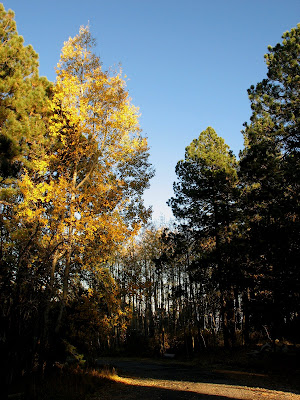
While the mountaintops' colors here are nothing compared to New England (or Korea) in the autumn, it is still a refreshing change to see deciduous trees' changing leaves:
Aspens in southern Arizona live only above the 8000-ft.-line, so the mountains behind Tucson are just tall enough to become autumnal. In another month or so, the first snows will fall on these slopes--Mt. Lemmon's ski-lifts are visible in this photo; it's the southernmost ski resort in the U.S.
On the way back down, we arrived at one of the vista-points just in time for sunset:
===
Fourteen years ago, I visited Korea in the autumn.
The mountainous spine along Korea's eastern coast burns with maples and gingkos in October and November:
(I am reminded of the ignorant question I was once asked by a fellow student, when he found out I was 'part-Korean'--"do they have trees in Korea?" Yes, oh ignorant erstwhile teen-ager, yes, they do...)
My stay in the country ended up coinciding with my grandmother's death.
I went to the mountains twice during that trip--
before her death, the slopes were still green;
after she died, the mountains were ablaze.
As predictable as the comparison may be, then,
fall's falling leaves always remind me of the end of a life...

=========

Our last patio-tomatoes of the year are still hanging on.
When I was a kid in Georgia, by mid-June our backyard would already be overflowing with the red orbs.
When I moved to Seattle a decade ago, I was amused by gardeners' valiant attempts to coax tomatoes to ripeness (by August or September!) by planting them along south-facing brick walls...
Here, it's almost November, and I'm still enjoying them, warm from the sunshine...
...even when the shapes are less-than-spherical:

========

October in Nicaragua--month of endless rains--at least that's what it was the year we lived there. No 'fall-colors' there--just lush green fields, chocolate-colored rivers, and our laundry drying on our window-slats. For weeks no one could get their laundry properly dry. School was even canceled for several days, due to parents not being able to launder and dry their children's uniforms! Hanging-socks--what would Gringo-home-magazines say to that as a 'window-treatment?'

=======

Last week, at one of the local high-school's pre-home-coming-pep-assemblies: in addition to the cheerleaders and football-players, the school's ballet folklórico troupe performed--twirling Mexican dresses on the girls, and guys in crisp white shirts, rythmically wielding machetes while kicking between the blades: local color, indeed.