Monday, February 19, 2007

Feb post # 2

...ah, the clichéd pastime of clipping cartoons from The New Yorker...
In this week's issue, I found this:
(I confess--I didn't know exactly know what a "Japanese enzyme bath" was,
so, this being a day off, I googled it: click on this for a brief explanation, if you care to know...
)

At any rate, what do YOU think--are blogs are as obnoxious and omnipresent as the cartoon portrays?
Surely, this blog isn't as in-your-face and inane...


As proof thereof, behold the scan below, a result of grocery-shopping this past weekend at H-mart.
I came across this packet of cookies, which I had to buy, just for the packaging:

Indeed, 'happy and joyful time'...(prounce the Korean: 'choh-koh-tin-tin')
!!Biba Engrish!!

You might want to take those smiling gender-specific treats for lunch,
in your very own tin lunch-box, decorated thusly:

(Thanks to my friend Bl... for giving me a scanned copy of this décor...)

This time of the year, when my wife and I inevitably begin talking about moving somewhere sunnier, when the grey sky descends lower than the hilltops, inducing a S.A.D.-attack, we do often ask each other--"what, are you a problem?"
That helps, you know.


In the other room, right now, our parrots are tweeting, repeatedly saying "Good bird! good bird!"

That deserves to be announced, definitely...

Speaking of birds, then...
What's with this sign?
Who was the graphic designer who came up with this 'canine' profile in an area park?
We thought the sign should read "no DUCKS allowed"...


And speaking of art...a few weeks ago, on a miraculously sunny Sunday afternoon, we walked through the newly opened Seattle Art Museum outdoor Olympic Sculpture Park...Metallic tree. Cool.

Metallic.
Kind of like the color of this frozen lake:

Last Monday, my wife and I were flying back to Seattle from a weekend trip to Kansas City, and as we approached Salt Lake City (where we had to change planes), we saw the above view...
NOT the Great Salt Lake...can anybody help me out here?
Remember, 'without geography, we're nowhere.'

Wednesday, February 07, 2007

February. Escape.

La gripa.
The flu--a legitimate excuse to sit at home in one's pyjamas...
...to update one's blog (January was a ONE-entry month?)...
...and an opportunity to daydream about escaping...
...about escaping winter's darkness...(see poem at the bottom)
And so my wife and I are going to be visiting friends in California later on this month...


A year ago, though--
we were thinking of escaping the dusty heat of Nicaragua's November-to-May 'verano.' Forgive the medical details here, but last year I suffered from several weeks of sleeplessness--insomnia due to a rash! I began thinking that we would have to leave Leon prematurely, it was so bad...

So I went to a local dermatologist.
The doctor's office was blessedly air-conditioned, and after examining me, la doctora said,
"Ah--this is normal this time of year. You're simply allergic to the air."


T
he 'air' meaning the 'dust'--the insecticide, fertilizer, burnt-garbage particulate that settles on EVERYthing in León before the rains return in May...Months of hazy skies and constant mopping: "Oh, is that all?" I remember thinking...Allergic to the air! Hmm...How does one avoid exposure to the air?


A bit of panic ensued, but then an injection, some ointment and travel plans calmed things down.

We were going to head north to Guatemala--
the cool and lush volcanic highlands of Guatemala, two countries to the north of us, and relatively dust-free...(well, at least the part where we were going.)
An old family-friend lives near Guatemala City, not too far from the Pacaya volcano (steaming above, seen from her neighborhood) and so we thought we'd go visit her for a week or so...


After having lived for half a year in León, Nicaragua, going up to Guatemala was like 'country-mouse' going on his first trip to town--despite persistent poverty and massive social ills, Guatemala is years ahead of Nicaragua, economically speaking. The shopping centers in the posh suburbs to the south of the capital are the equal of anything in Gringolandia. In one of those cool malls, I got my digital camera, which I learned how to use in our friend's neighborhood, taking advantage of sunsets behind volcanoes:
Just on the other side of the 13,000-ft.-high 'Agua' volcano lies the city of Antigua--the original Spanish capital of the country, founded in the 1500's. After several centuries of earthquakes, the authorities decided to move the government to present-day Guatemala City in the 1700's (which is still earthquake-prone, but further away from the volcanoes). After the administrative switch, Antigua sort of languished in undeveloped bliss, thereby avoiding the urban sprawl that characterizes most other Central American cities. It is a pastel-toned Baroque jewel tucked amidst three 13,000-ft volcanoes, surrounded by coffee and avocado plantations...Forgive the 'tourist-brochur-ese' here, but the place is seriously, absurdly picturesque.
Along the streets, Maya women still wear their traditional clothing, which they weave themselves, while they try to sell things to tourists.
At times, their selling borders on harrassment...but it's difficult to get annoyed when you realize how limited their livelihood really is...

And as beautiful as Antigua is, it's hard not to get annoyed at the 'Californication' of the central part of the city: art galleries, cappuccino-cafés, hotels and jewelry boutiques--all owned by foreigners--have crowded out and priced the local people out of their own city. The businesses and the customers would belong just as well in Santa Barbara or Sedona...Here's a cynical point of view: Antigua is almost a Central America-theme park: Come look at architecture and landscape, without having to be 'bothered' by the local poverty! And yet, what is there for such a place to do, aside from tourism?

Not wanting to be cynical, seriously...I'm not anti-tourism or anything...I mean you know I like cappuccino...
Just trying to have a balanced perspective at the pros and cons of the tourist industry in the third-world...

So. Go. It's one of the most beautiful places on the continent. Go and enjoy, and let your conscience be your tour-guide...


While we were living in Central America, my wife and I wanted to make sure to visit the Mayan ruins at Tikal. So after a few days near Guatemala City and Antigua, we caught a quick flight (45 minutes, as opposed to an 8 or 9-hour drive over bumpy roads) to the jungle of the Yucatán.


(double-click on the photo for a large-panoramic view)

It's a shame that Mel Gibson's recent hyper-violent depiction of the region may well be many people's only image of the Maya world... But I think back to my simplistic middle-school 'geography' education: In the brief mention that Meso-american cilivization warranted, it boiled down to this: Aztecs--BAD; Maya--GOOD!
Not so simple. But very impressive. And to get up early and hear parrots, toucans, and howler-monkeys in the trees around the millenia-old stone structures: unforgettable.

I had expected to be dripping with sweat while clambering around the ruins, but a freak-cold-front had pushed through, and the Yucatán peninsula was having its coolest temperatures in decades, so my wife and I had the 'cheater-experience' of exploring Tikal in temperate comfort, not even having to swat at mosquitoes...

A day and a night and a morning, and then the following afternoon we were back on the plane to Guatemala City. As much as that capital city is an armpit, the flight approach to its airport is postcard perfect:
Yes, yes, I know--I'm obsessed with photos of volcanoes.
But this is all about escapism. Escaping the dust by fleeing north to volcanoes and Mayan jungle...escaping the flu-blahs by sitting here and browsing through old photos and writing this blog...escaping Seattle's grey-darkness by going down to San Diego in a couple of weeks...


Before signing off, though...

...one of my favorite poems about this time of year, by a writer from Canada,
where they know how to do winter:


February
by Margaret Atwood

Winter. Time to eat fat
and watch hockey. In the pewter mornings, the cat,
a black fur sausage with yellow
Houdini eyes, jumps up on the bed and tries
to get onto my head. It’s his
way of telling whether or not I’m dead.
If I’m not, he wants to be scratched; if I am
He’ll think of something. He settles
on my chest, breathing his breath
of burped-up meat and musty sofas,
purring like a washboard. Some other tomcat,
not yet a capon, has been spraying our front door,
declaring war. It’s all about sex and territory,
which are what will finish us off
in the long run. Some cat owners around here
should snip a few testicles. If we wise
hominids were sensible, we’d do that too,
or eat our young, like sharks.
But it’s love that does us in. Over and over
again, He shoots, he scores! and famine
crouches in the bedsheets, ambushing the pulsing
eiderdown, and the windchill factor hits
thirty below, and pollution pours
out of our chimneys to keep us warm.
February, month of despair,
with a skewered heart in the centre.
I think dire thoughts, and lust for French fries
with a splash of vinegar.
Cat, enough of your greedy whining
and your small pink bumhole.
Off my face! You’re the life principle,
more or less, so get going
on a little optimism around here.
Get rid of death. Celebrate increase. Make it be spring.

( from PoetryFoundation.org )

Wednesday, January 10, 2007

January--now & a year ago...

A snowy evening--always makes one perfectly content to be coccooned with a hot beverage and carb-rich snacks (preferably involving chocolate)...


Just around dinnertime tonight, it began snowing here--a repeat of the snow-'storm' o
f last November--and within a couple of hours, four inches had accumulated! As the temperatures are not forecast to rise much above freezing for the next few days, I guess we'll have the white stuff around for a while... Even though the Seattle-area is the northernmost major metropolitan area in the continental US, (we're even further north than Minneapolis, Toronto, and Montréal!), snow in the lowlands is rare enough to warrant live news coverage, with journalists showing snowballs via live satellite feed...(that's why we launch multi-million-dollar objects into orbit after all, so I can see live snowballs from ten miles down the road...)

This second snowstorm of the season did hit, though, like the first, right at rush hour, causi
ng infernal commutes...Fortunately my wife and I were both home so we could enjoy the following view, with the brake lights on the freeway in the distance obscured by the falling flakes: Just yesterday, it was an unusually mild day--in the fifties--and we saw a bald eagle (!) gliding among those same treetops....

What a difference from a year ago in Nicaragua, when my wife and I were waking up to
80 degrees and thinking, 'wow, sure feels nice and cool this morning! Seriously.

January on the Pacific coast of Nicaragua is early enough in the dry season (Nov. to May) that the landscape is still green, the dust is still mostly on the ground instead of in the air, and trees are in bloom.
This is a llama del bosque (flame of the woods), whose red blossom-clusters are the size and shape of grapefruits that have been cut open and divided up into segments:


I never did learn the name of this tree, whose lavender 'pomander'-clusters were accompanied by foot-and-a-half-long 'string-bean' seed pods:

(Behind the tree is the house where we lived in the "FUNDECI" section of León--we rented out the second-floor from neighbors who became our good friends.)

Bananas are always in season in Nicaragua, so I couldn't resist arranging them on our dining table for the following photo--the huge green squarish ones (plátanos hawaïanos) are ideal for making tostones (flat plantain disc 'french fries'), and the itty bitty bananos dátiles have a hint of green apple flavor and are perfect for eating like candy. The intensely purple fruit is a pitahaya, which grows on a cactus-vine--scoop out the staining flesh, add sugar and ice water and blend and voilà: un refresco típico de León...
And here's what the pitahaya grows on:
Another fun Nicaraguan drink-fruit, is the calála:
Despite the fact that the interior resembles orange fish-eggs (mmm: roe!), the passion-fruit-relative is like a natural TANG concentrate. (Who else grew up drinking that powdery 'astronaut'-beverage once in a while?) Again, add water, blend, strain, add azúcar, and the 95-degrees-in-January-lunch-time becomes more bearable...

A friend of ours lived a couple of miles out of town, and so had a bit of land. She had a very modest house, but lots of fruit trees, including this 'palo de papaya: '
Amazing, eh?, how those massive fruits grow directly out of the trunk, like giant barnacles on a pole...
And they do get to be giant-sized, up to two and three-feet long!

Another benefit of being 'snowed-in' then, is the guilt-free time one can spend perusing past photos of tropical fruit and thinking that other people might care.
Ah, nostalgia...

My former piano teacher, now in her 70's, informed me that when she was growing up (in England), she was taught that "to insist on talking (or writing) about the passing of time and the weather in ones correspondence is to reveal a paucity of worthwhile thoughts." Tongue-in-cheek, she wrote that in a letter to me once, right after mentioning precisely those things...
So...
Can you believe it's twothousandSEVEN, then!? And that it snowed?!
What's the weather like where you are? Yes, I care...

(Man, I'd love to have some pineapple in the morning--fresh from the field, carted into town by a skinny horse, bought for mere pennies...)

Friday, December 22, 2006

Sun-rise/-set/-worship

It's the middle of the night of the longest night of the year;
tomorrow the days finally start getting longer
as the northern hemisphere will begin to tilt away from winter solstice...
(Those who don't live at a northern latitude might find people's daylight-obsessions up here, well, obsessive...
a few years of wintertime light-starvation would give you insight...)

Although the days are short right now,
the low angle of the sun does make for the occasional spectacular sunrise when the grey lifts,
such as this scene from 8:00 a couple of days ago:


...and then by 4:15 p.m, the sun is already going down again, ("sunrise,... sunset,...swiftly go the days" oy...)
turning Rainier's snow-blown slopes purple in the afternoon-night:

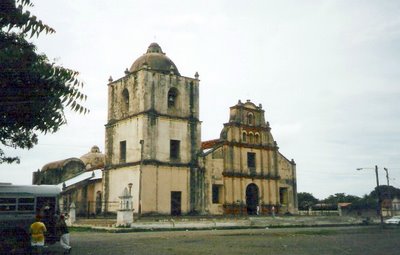
Now, on to the 'sun-worship' portion of tonight's posting. Thus, this photo of a Nicaraguan church:

The Iglesia de San Juan Bautista de Subtiava, begun in 1698, presides over the opposite end of León from where my wife and I lived last year. Age lends its slight decreptitude a patina of stateliness, no?

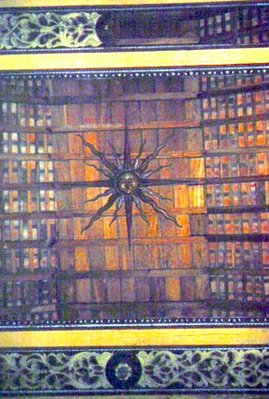
When you enter the pillared interior, look up, and you'll see this: The Spaniards carved and mounted this gilt-tinged sun in an effort to persuade the local Subtiava índios to come worship in the new structure. 'You worship your god, I'll worship mine--let's just all do so under the same roof.' Something like that, at least. Evidently, the artistic endeavor paid off, and for three centuries now the religious syncretism has been at work. Sun-worship, colonial-Nica-style...

( On the longest night of the year, isn't it appropriate to mention sun-worship, especially with Christmas coming up, what with its links to Saturnalia and 'The Birthday of the Unconquered Sun' in Roman times? )

On a non-sun theme, Paquito our parrotlet began repeating something new today--and it's most definitely Nica-related: "Va pue'!" That thoroughly and unmistakably Nicaruguan phrase can mean so many things: "okay, then"..."I hear ya man"..."see you later"..."take care"...

So, then: May the sun shine on you, dear reader. Va pue'!


Monday, December 18, 2006

Epilogue to windstorm

When I wrote a few days ago, I didn't realize how serious last week's windstorm here had been.
The peak winds were 69 miles per hour--a record for highest windspeed recorded in Seattle.

Our top-floor apartment-on-a-hill has a wide balcony facing south, and so the sliding glass doors,
for several unrelenting hours, were literally and noisily bowing inward last Thursday night....

fortunately they didn't shatter.

At its worst, up to a million were without power;
even now there are still thousands of homes without electricity,
and with
the sub-freezing nights,
local shelters and motels packed.

(My wife's parents, along with their, alas, crated dog,
have been 'camping in' with us since last Friday.)
The school district where I work, along with many others, canceled school last Friday...
...and also today...and also tomorrow...which means I don't go back to teaching until January...whi
ch also means I'll probably be in the classroom until the end of June...

The cold nights are LONG right now:
sunrise isn't until around 8:00 a.m. and sunset is around 4:15 at this latitude...
Darkness...

(There have been dozens and dozens of cases of carbon-monoxide poisoning--people, including many immigrants/refugees from Somalia, bringing barbecue grills indoors to cook and get warm, ay ay ay...)


So, with winter storms on the mind, here's a semi-gratuitous photo of the Paris skyline--a passing winter storm (that's a snowsquall you s
ee to the right of the Eiffel Tower) seen from 'my' window way back in the winter of '98-99:
But, to have something summery to visually counteract this northern S.A.D.-ness,
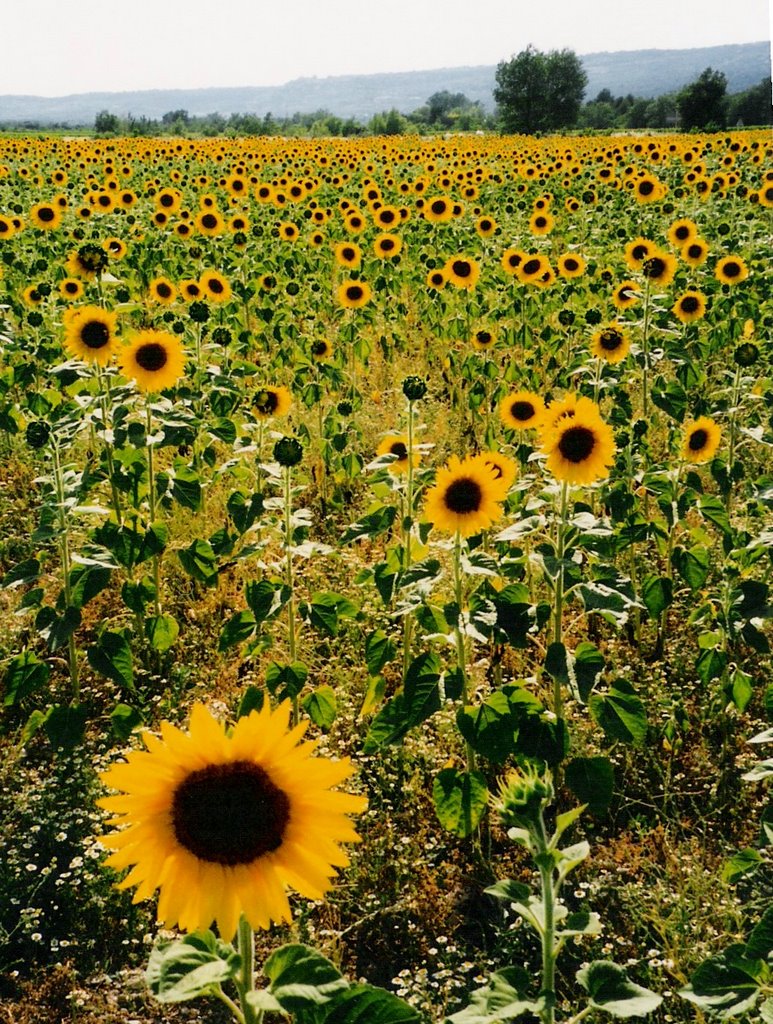
a photo of sunflowers in Provence; cliché, yes, but no less bright:

...while I'm browsing old photos from the first time I went to the south of France,
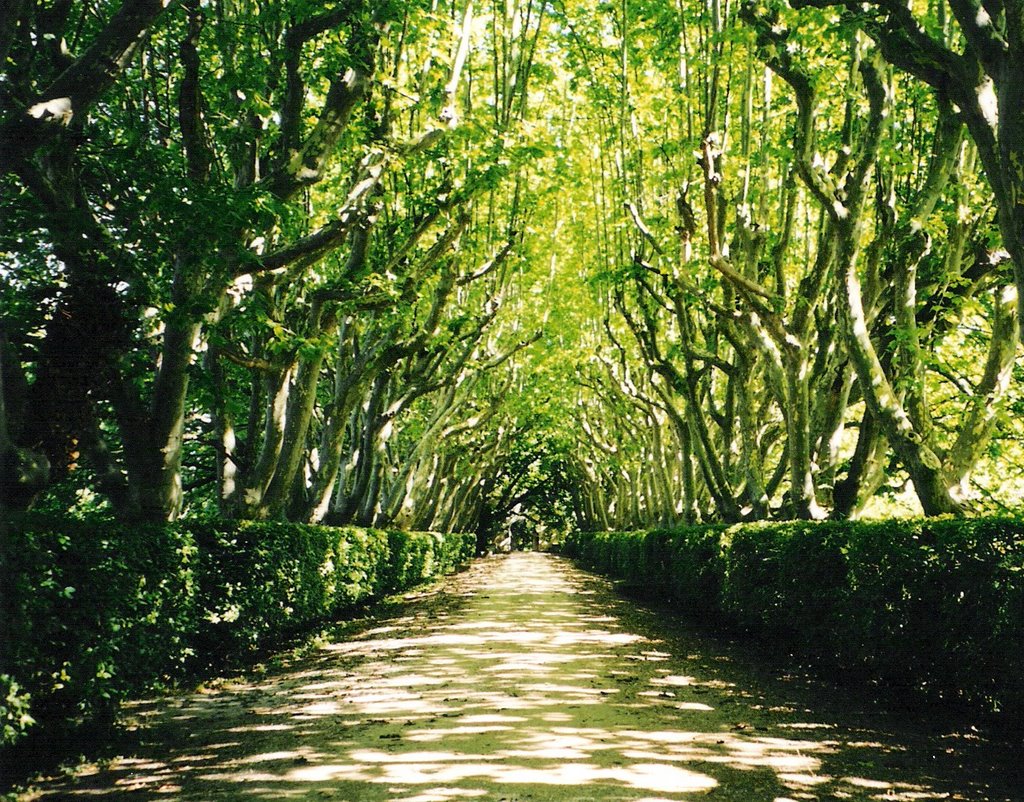
here's a typical scene of a shady country road a few miles outside Avignon:


But, since this blog IS 'post-NICARAGUA,' here's a view from down there:

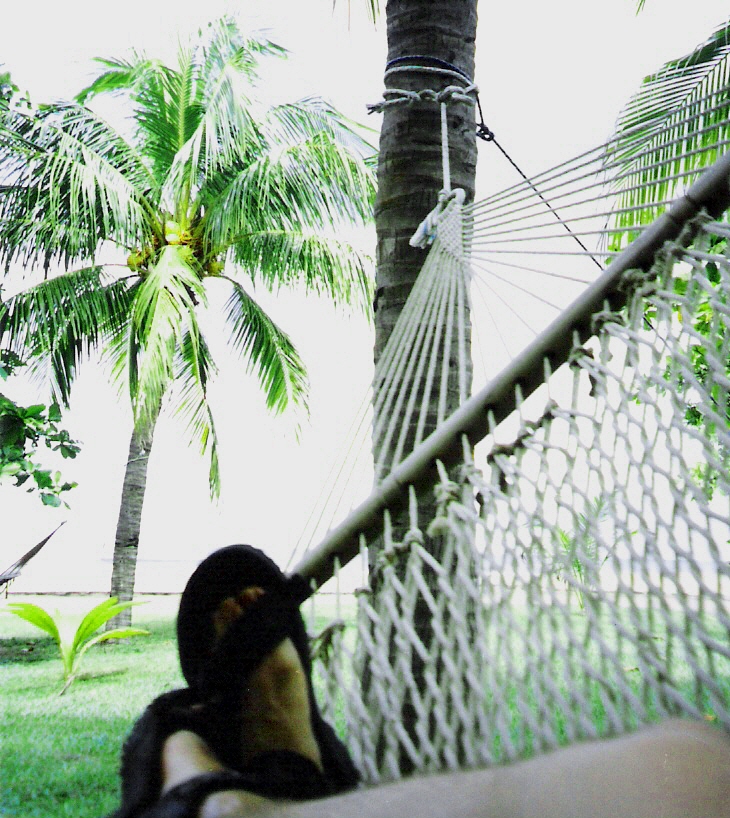
--a hammock's-eye view from my lifelong dream to lie under coconut palms, swaying in the afternoon breeze coming off the Pacific at a beach resort...

...in this case, Montelim
ar—Nicaragua’s only 5-star all-inclusive beach resort (and surprisingly affordable!).

It began its life as the private beach get-away for the Somoza family during the years of their dicta
torship.
The ‘dynasty’ of a father and his two sons lasted from 1937 to 1979 (with a few years of ‘elected presidents’sprinkled in). The road that leads to the property was, at one time, one of the only paved roads in the country. Imagine. When the dictatorship was overthrown, the property was used as a military base during the Sandinista years, and finally was transformed by a Spanish company into a tourist-destination. Not every beach-hotel has such a storied past, eh?

The original mansion is now a casino and restaurant/discotheque. Nearby is the new hotel—all rooms with balconies facing the ocean—and ‘cabanas’ built among palm and almond trees with lush (litter-free!!) gardens…A toucan-&-parrot enclosure, huge pool, swim-up bar, all-you-can-eat-and-drink—My wife and I had never stayed in such a place. It felt like being in a different country. When we got off the bus from Managua, the transportation from the little town to the resort was in the form of caponeras--the local word for bicycle-taxis--vehicles for ‘rider-guilt;' it feels strange to pay someone to use pedal power, huffing in the heat, to move you and your luggage while you just sit…

As my wife and I are “word-nerds,” you can imagine the delight we experienced at the resort's dessert buffet, seeing the occasionally misspelled multilingual labels for the sweets.
Our favorites were:

“sheesecake” HA!
(just begging to be used as a euphemism; sadly, more fun to say than to eat)

“coconut flawn”
and, more mundane, "carrotscake”


So far, that weekend at Montelimar has been my 'one-and-only'...
Winter nights lend themselves to dreams of palm-shaded warmth, no?

Friday, December 15, 2006

Paquito--Pyongyang--Public Radio--Poinsettia

These four P's DO have a logical link;
may I ask for your patient perusal, please...

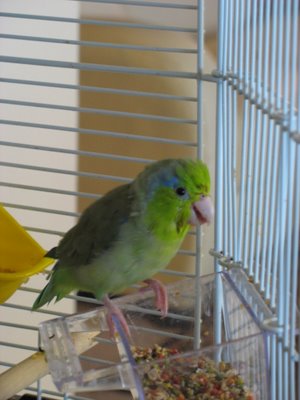
Paquito, our parrotlet, has just added a new item to his diminutive lexicon:
"dear leader,"
( pronounced more like de-ah lea-dah, actually)
WHY? you ask...
Well...he's little. And it's fun to hear him say silly things.
(Up to now, he's said "Salut" & "Paquito," & "ça va?")

So, the other day, when I was looking at him while his head feathers were fluffed up,
I thought--hey, that reminds me of Kim Jong-Il--the reclusive and bizarre dictator of North Korea.who inherited the throne from his father Kim Il Sung...in his country's personality cult, he was referred to as 'Great Leader,' ergo, his son, logically, must be called "Dear Leader"...
He must have the strangest hair-do of any head of state today--witness the state of his head:

So, as a joke, and to my wife's bemusement,
I began squawking 'dear leader' to our little bird--especially when he would look like this:

yes, he looks a bit crazed...all the more reason to be reminded of the North Korean dictator, as he postures in Pyongyang, his capital city...

And then just a couple of days ago--surprise!--Paquito pronounced the phrase--in a high-pitched repeated recitation: de-ah lea-dah! deah leadah! deah leadah! deah leadah!
Yes, I know--resemblance is in the eye of the beholder.
But a parrotlet that, ahem, parrots, North Korea's party line, is quite amusing.
(Disclaimer to Homeland Security here:
I IN NO WAY SUPPORT NOR SYMPATHIZE WITH NORTH KOREA!
PLEASE HAVE A SENSE OF HUMOR!!! I AM SIMPLY POINTING OUT A PASSING RESEMBLANCE...
I AM COMPLETELY POLITICALLY NEUTRAL IN A MOST BENIGN WAY!!
I HAVE PARROTS,THERE I AM SLIGHTLY WEIRD...BUT HARMLESS!!)

Let's hope that works...

So, now on to Public Radio.
(The link between Pyongyang and NPR is this:
I listen to NPR, therefore I am informed about international goings-on, including things North Korean.)
There.
Now, yesterday, while listening to KUOW, NPR's local affiliate, there was a talk show mentioning, among other things, that a recent study concluded that Seatle is America's 'most literate city.'
(That 'literateness' must be one reason why, evidently, I insist on writing with numerous subordinate clauses, this being, parenthetically, an example thereof. Call it peer pressure...)

The self-congratulatory tone of some of the people calling in being annoying, I decided to call in--my first time ever trying to talk on a radio-call-in-talk-show--and they took my call!
I had my 30 seconds of local Nerd-Power-Radio fame.
I don't recall exactly what I said, but it was something to the effect of, 'okay, we might enjoy that we live in a 'literate city,' but don't let it go to our head--oh we're so educated, oh we're so literate--let's not let the findings of this 'study' nurture a self-superiority complex...'
Anyway...

To get another point of view on the local 'literate' pulse,
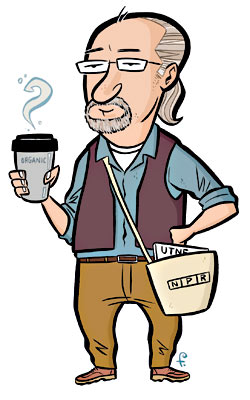
read this column here (entitled "Ask an uptight Seattleite"), from where I copied the following drawing.
(all due credit to The Seattle Weekly.)
As a neo-Northwesterner, I find the caricature to be right on:

Let's start with the shoes--suitable for hiking, no doubt, and probably Gore-tex. (weather update--we had a WINDstorm last night, power is out to 700,000 people as I type this, and schools are cancelled...) The NPR-tote-bag is a must, because, as a 'literate' person with a thirst for news, the only right thing to do is be a contributing member, which fact one can subsequently advertise with the 'gift.' And inside that (hemp fiber?) bag, full of reading material, naturally, one must have Utne reader magazine, which you can pull out when you stop for your organic soy latte made by a multiply-pierced barista at a NON-Starbucks establishment, to ensure onlookers that you don't allow pre-digested pablum, such as Fox 'news', to bias your westcoastworldview...which is seen through small de rigueur wire-rimmed glasses...

Living in such a literate place, I have been surprised, then,
by the occasional playing out of the following dialogue, which I am not making up:
person asking question:
So, where did you live last year?
me, replying:
In Nicaragua.
person asking question, earnestly:
Ah, Nicaragua...(thoughtful pause)..now, where in Africa is Nicaragua?
me, suppressing natural reflex to express, facially, my surprise at the geographical non-awareness:
Umm...actually, it's in Central America...

In all seriousness and sincerity, my point here is not to make fun, but just to point out how 'literate' we are here...
No, really, seriously--this shows how geography and world-awareness are not taught in schools here.
Washington state, in fact, does not even require world history for high school graduation. (gasp of horror!) So literate. You have to have Washington history, ( all 150 years of it ) and US Government...but the rest of the world, well, you know, if you just listen to NPR and browse at Barnes & Noble once in a while, you'll get what you need...you know...
Okay. So Nicaragua...
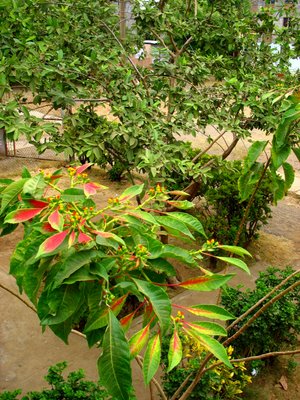
and my fourth P for today's posting: Poinsettias:

A year ago, that was the view out our second-floor front-door in Nicaragua: a tree-size poinsettia, in its natural habitat. (Behind it is a guava tree. Yes. I know. An excuse for a gratuitous Nicaragua photo...but hey, there are literate people out there who don't know that poinsettias are tree-sized plants in their tropical homes, not just foil-wrapped December-décor...)

And while Nicaragua--and Africa--are on the brain, here are a couple of book reccomendations (remember--literate!!) if anyone wants to know more about where Nicaragua is not. I just finished them:

King Leopold's Ghost, by Adam Hochschild

( from Amazon.com)--King Leopold of Belgium, writes historian Adam Hochschild in this grim history, did not much care for his native land or his subjects, all of which he dismissed as "small country, small people." Even so, he searched the globe to find a colony for Belgium, frantic that the scramble of other European powers for overseas dominions in Africa and Asia would leave nothing for himself or his people. When he eventually found a suitable location in what would become the Belgian Congo, later known as Zaire and now simply as Congo, Leopold set about establishing a rule of terror that would culminate in the deaths of 4 to 8 million indigenous people, "a death toll," Hochschild writes, "of Holocaust dimensions." Those who survived went to work mining ore or harvesting rubber, yielding a fortune for the Belgian king, who salted away billions of dollars in hidden bank accounts throughout the world. Hochschild's fine book of historical inquiry, which draws heavily on eyewitness accounts of the colonialists' savagery, brings this little-studied episode in European and African history into new light.

and A Continent for the Taking, by Howard W. French

( From Publishers Weekly)--Although both tragedy and hope are mentioned in the subtitle, this work of reportage on Africa focuses more on the former than the latter. French was first captivated by Africa after college, in 1980, when he joined his parents and siblings in Ivory Coast. Taken by the pride and beauty he found on the continent, he became a journalist there, eventually serving as a bureau chief for the New York Times. His strength as a reporter is evident as he takes the reader across the continent, recounting in vivid detail the genocide in Rwanda and the AIDS and Ebola outbreaks. His prose is evocative without being melodramatic in describing the suffering he saw. The "powerful and eerily rhythmic" wailing of those who had lost loved ones to the Ebola virus "was painful to hear, and clearly bespoke of the recent or imminent deaths of loved ones." French is just as eloquent discussing his ambivalence about covering African crises after criticizing other journalists for their pack mentality in focusing on such crises rather than on giving a more rounded picture of life on the continent. In addition to disease and murder, French focuses his book on Africa's other plague: corrupt tyrants. While his insights into Zaire's Mobutu and Congo's Laurent Kabila are valuable, like many other writers on Africa French excoriates the "treachery and betrayal of Africa by a wealthy and powerful West." But providing some ways to improve life thereâ€"to give Africans some hopeâ€"is not so easy. As his book shows, French might be exactly the kind of seasoned Africa observer who could help point the way.

Solomon of old had it right: 'to the making of many books there is no end, and much devotion to them is warisome to the flesh.'

Now.

May we all go out and live our literate-enough-but-not-overly-so lives.


Monday, December 04, 2006

In today's IHT,...
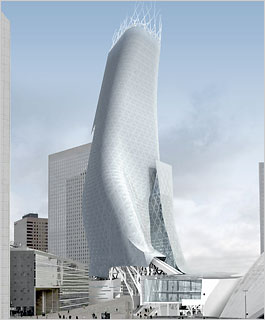
While reading today's International Herlad Tribune online today, I saw this picture in an article about upcoming architectural additions to Europe's skylines:

I love Paris (having lived there 1998-99), and I love skyscrapers, so I just had to save the photo from the article and include it here. Called "Phare" (lighthouse), the tower is scheduled to be completed by 2012 in the "La Défense" district in western Paris.

...below is an excerpt from the article:

Designed by Thom Mayne of the Los Angeles-based firm Morphosis, the Phare Tower will rise amid the office towers of La Défense, the western business district conceived in the late 1950s as a way of expanding the city while protecting its historic core from overdevelopment. Embedded in this maze of generic towers and blank plazas, the tower will overlook the hollow cube of the 1989 Grande Arche and the elegantly arched concrete roof of the 1958 C.N.I.T. conference center.
Mr. Mayne dug deep into the site's convoluted history to create a building of hypnotic power. Viewed from central Paris, the building's gauzy skin, draped tautly over the tower's undulating form, will have the look of luxurious fabric. But as you draw closer, the forms will appear more muscular, with massive crisscrossing steel beams supporting a perforated metal surface.
The aura of the veil has a titillating vibe, but there is nothing superficial about this design. By drawing on what energy the site has - a tangle of roadways and underground trains - the tower transcends La Défense's deadening urban reputation. Supported by a series of gargantuan steel legs evoking a tripod, the tower straddles the site, allowing pedestrian and train traffic to flow directly underneath. The skin lifts up to envelop a nearby plaza, linking it to an underground train station. Beneath this perforated metal skirt, gigantic escalators shoot up more than 100 feet to a lobby packed with restaurants and cafes.
The approach recalls the machine-age fascination with physical and social mobility that yielded masterpieces like the Gare de Lyon in Paris and Grand Central Terminal in New York. Pushing the idea further, Mr. Mayne rips the top off an existing plaza to reveal the trains and traffic passing underneath. As you ride up escalators link
ing the plaza to the lobby, seams open up in the building's skin to create vertiginous views of both an underground world of shadowy figures and the monuments of the beloved city past the Arc de Triomphe to the east.
The notion of building as machine is tempered by the structure's earnest environmental agenda. Double-layered skin on the south side of the building will deflect the harshest sunlight. On the north side, the surface peels apart to reveal transparent glass skin. The tower's peak, conceived as an extension of the skin, seemingly fraying apart in the breeze, consists of a cluster of antennas and a wind farm that will generate electric power.

Not exactly another Eiffel Tower, but definitely a tall statement...

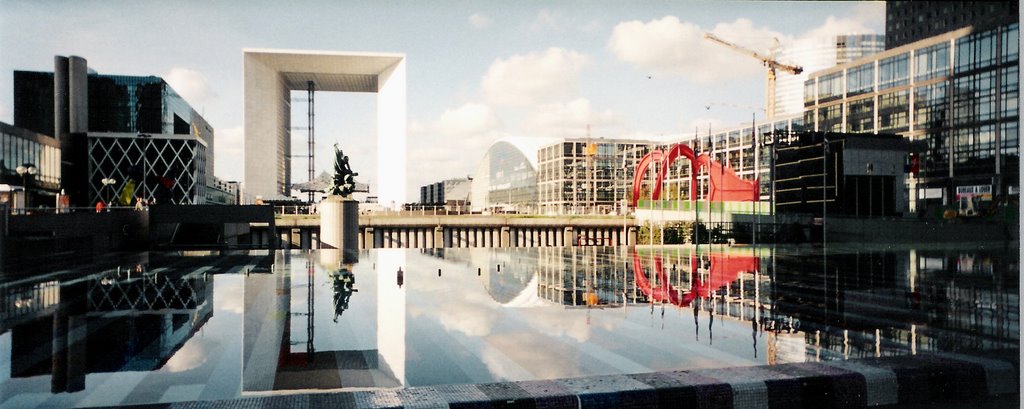
When I lived in Paris, I was only a ten minute express-commuter-train ride away from the "La Défense" district. If I understand the article correctly, the new curving tower will be built approximately in the location pictured in the center of this photo:
The IHT article mentions the 'hollow cube'...well you see it clearly above--a thirty-story hollow building, with a façade of white Carrera marble; the entire edifice of Notre Dame Cathedral can fit inside the modern structure, which was built as a modernistic office building/'monument' to commemorate the bicentennial of the French Revolution in 1989. (The Eiffel Tower was built in 1889 for the first centennial, and for decades remained the tallest man-made structure in the world)

I used to take the train to this neighborhood to run errands (of the book and cd purchasing kind) once in a while; and I admit that I occasionally stopped at the local McDonald's...for a cheap cup of espresso...

To put the La Défense skyscraper-suburb (location of most of the headquarters of France's big finance/computer/insurance, etc. companies) in context, look at the view below, taken a few miles away from the top of the Arc de Triomphe, looking west:

In order to keep the harmonious historical character of Paris intact, the city's building codes do not allow skyscrapers, so they have been 'exiled' to the 'burbs...That's not to say that Paris is anti-modern; far from it. What today passes for 'typically Parisian' was, when it was built, revolutionary and modern. The uniform facades of mansard-roofed buildings lining straight tree-lined avenues that connect plazas and parks--that was all 19th-century 'modern' urban planning... And the city continues its quest to stay modern by commissioning ever newer monuments and buildings...just no more skyscrapers in the middle of the city...

(I couldn't resist: here's a night-time, street-level view of the Arc de Triomphe from the middle of the Champs-Elysées:)

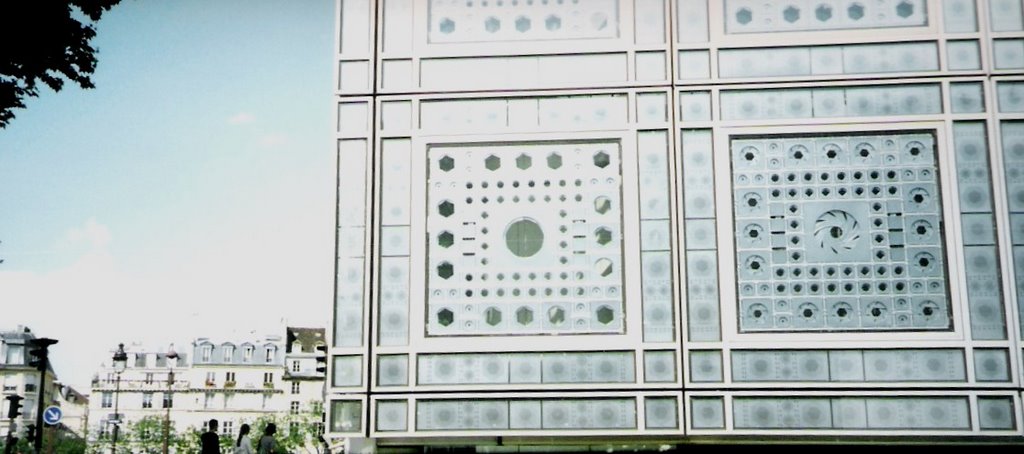
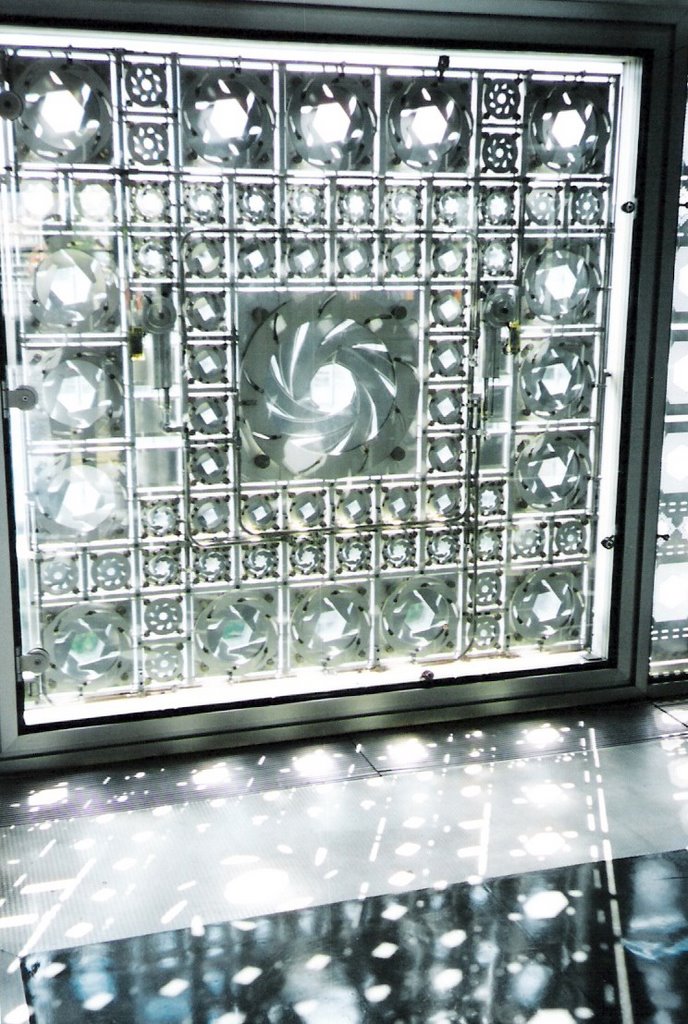
Another example--my favorite modern building in Paris--is the Institut du Monde Arabe. Here's a portion of its 10-story ultra-modern glass façade:
Each gigantic 'pane' of the facade has metal 'lacework' that can be opened or closed via computer--kind of like giant camera-shutters, to let in much or little daylight:
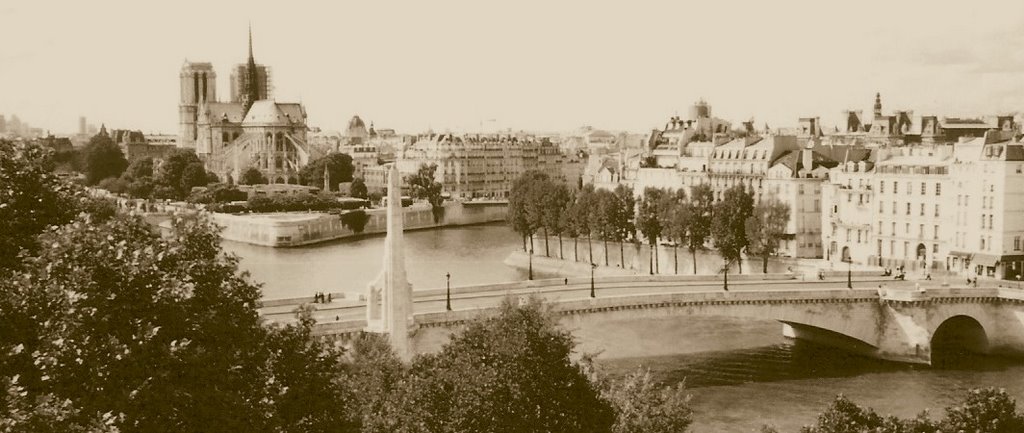
And from the rooftop café-terrace of the Institut, you get this classic view of central Paris--the back of the l'Ile de la cité with the flying buttresses of Notre Dame, and a couple of bridges over the Seine, linking the left bank to the Ile St-Louis, and the Ile St-Louis to the Ile de la Cité:


Finally, to close out today's newspaper-inspired architectural reminiscence of Paris, a less-than-monumental example, found in a commercial-ghetto of a suburb south of the Seine:
Oui, mon ami, you're looking at a car-dealership with a car-vending-machine!
Parking's a pain in European capitals, so the smaller the better, n'est-ce pas?
I wonder how many Euro-coins it would take to get your vehicle to come out the bottom...
and remember:
if your purchase gets 'stuck,' don't try to shake the machine or tip it over, s'il vous plaît...