Wednesday, October 15, 2008

What's an "alp?"

So, after yesterday's receipt of the Swiss materials, and after last night's photo-posting, today I decided to show the Swiss-dvd to my classes--a last minute lesson-plan change, which worked out well since a good chunk of the students were gone for various testing reasons...

I thought I would begin by asking the remaining kids, "So, what comes to mind when you hear the word 'Switzerland'?" The inevitable chorus of responses: cheese, Swiss army knives, chocolate, cows...
But then with one group, mostly freshmen, I asked, "so, what do you imagine the country looks like?" I thought, surely, all the kids will say 'mountainous,' 'green,' 'the Alps,' you know...

Then I heard the question--"what's an alp?"
Seriously, they'd never heard of "The Alps."
I guess here in the Desert SW, we are somewhat far away from Europe...
...but really, not knowing or never having heard of 'The Alps'?!
Well, now, they have.
They actually oohed and ahhed at the cheesily-narrated but beautiful DVD, for example at the footage of gondolas floating over the peaks--such as the view from above the Schilthorn, above.
"What do they speak in Switzerland?"
"uhh.....Swedish?"
"Umm, no, that's in a different country. Sweden."
"Oh...Swiss?"
Well, now they know that there are four official Swiss languages, depending on the region, but no "Swiss" language:
Also, very few kids had ever seen "The Sound of Music."
But they do know that the Governator (a.k.a. California's Schwarzenneger) is from Austria.
So, that's encouraging.

Random facts.
Geo-cultural disconnects.
High-school.


Tuesday, October 14, 2008

...inspired by Swiss-provided educator freebies...

...but first, I feel obligated to backtrack a bit, to our few days in Seattle at the end of last month...
before that, though, this cell-phone-camera-shot from Sunday evening:


It had been a while since we'd been to Sabino Canyon--just a ten-minute drive from home! Ahh...a sunny reminder of why we enjoy living in Tucson; good to remind ourselves of that as our few days in Seattle did tug at our hearts a little...

...while up there a couple of weeks ago, we squeezed in time to have an espresso at my old grad-school favorite: Café Allegro, a half-alley-block away from the University of Washington. "Friends don't let friends go to Starbucks," proclaim a few bumperstickers in Seattle...And this coffeeshop does indeed date from the indepedently-owned pre-$4-latte-era.


Our running around included a stop at H-mart, where my cell-phone allowed me to capture this charming example of 'engrish:'
...feeling 'snacky snacky,' anyone? Asian junk-food, marketed to children, to go-go...(I do miss the pan-Asian presence in Puget Sound...)


Of course, the primary reason for our trip was to attend my wife's brother's wedding. And my wife's sister, K--, did the flowers, so we were volunteered (seriously, we did volunteer) as flower-laborers. I was drafted to become boutonnière-boy. (Now there's a skill I never thought I'd pick up.) We were up until 2 a.m. the night before the wedding. K-- did a wonderful job on the bride's bouquet; what do you think?


The wedding was held at a lakeside community center/lodge. September weather in the Pacific Northwest is never a sure thing, so we all felt particularly smiled upon to have a sunny Satuday in the 70's for the wedding--uncommonly perfect, with fog lifting off Mt. Rainier's glaciers in the lake-and-evergreen-framed distance. A visual cliché, perhaps, but no less beautiful.


It was one of those days that Seattlites live for, one of those days that makes the months and months of a low grey ceiling worth it...(right?...and, I have to include a little bit of Tucson-pride here--it was one of those days that is as common in Tucson as it is rare in Seattle...of course, we have no glaciers and no lakes here...trivial detail...)


And so that brings me around to the 'subject line' of this entry--'inspired by Swiss-provided-educator-freebies.' Yes, teachers love pedagogically-useful freebies, and the cultural service of the Swiss Embassy recently made an offer to teachers to provide a packet of information, including DVD, CD, maps, booklets, etc...So I sent off for it, and it arrived today...After dinner, S-- and I watched the DVD--the obligatory fly-over panoramic sweeps of impossibly picturesque alpine meadows--more visual clichés, but it is almost impossible to overrate the scenicality (?) of Switzerland. It got me all nostalgic for the summer I spent in Switzerland on a study-abroad program--wow, I just realized it's been twelve years ago...


During the years that I lived in WA, I loved hiking the Cascades, and the northern section of it was often called "The Switzerland of North America." (Interesting how places in Europe are always the touchstone for places elsewhere--Beirut, the Paris of the Middle East; Korea, the Switzerland of East Asia; Bangkok, the Venice of Asia; Buenos Aires, the Paris of South America: etc. etc...) Well, here are a few scanned photos from the 'original' Switzerland.

The immensity of the Eiger-Mönch-Jungfrau massif is impossible to convey in a photograph. The verticality is overwhelming. Coming into the Lauterbrunnen valley from Interlaken (1864 ft. above sea level), you round a bend, and then immediately, you have to crane your neck to look to the top of the 13,025 ft-high peak of the Eiger; over eleven-thousand feet almost directly skyward, in your face. The setting is, forgive the unimaginative travel-writer-ese, seriously, one of the most beautiful spots on Earth:


(alas, the above photo is not mine; it is courtesy of this link.)

My 'home-base' during that summer was in the French-speaking city of Neuchâtel, built of butter-colored stone, stretched out for miles between the Jura mountains and Lake Neuchâtel, with the Alps off to the south. The lake actually produces a microclimate, so that vineyards and even the occasional palm tree line the shore, while just over the hills to the NW, the Jura valleys experience the coldest winters in Western Europe.

I remember very clearly, sitting on this stretch of lakeshore, writing a letter to my parents. It was heady to be a young American college student in Europe, studying languages, soaking up the architecture and the sun, traveling on scholarship-funds...heady, but bittersweet, while my father was undergoing chemotherapy across the Atlantic. My parents had insisted that I go--staying home wouldn't have really changed anything, they said; the chemo would end up being as good and as bad as it would be no matter where I might be. Fortunately, my father pulled through and would live another year...


==========================================

Here's a postcard I scanned:
--the southern Swiss town of Sion, the medieval bastion garding the Rhône-valley. Two outcroppings topped with the two powers of the Middle Ages--temporal, a castle on the left; ecclesiastical, a church on the right. Climbing to the top of the rocky hill on the left, I got this view of the fields to the east, where the language changes to German a few miles upriver:

and this view to the west, through the gate, to another hill, covered in vineyards. This valley's northern slopes are known for their white-wines...


Several miles to the south of the town is the huge Grande-Dixence dam, built at about 8000 feet, above the tree-line. It contains more concrete in volume than the stones in the Great Pyramid in Giza; itis one of the tallest dams in the world, about the height of a 100-story building. Living downstream from it must be surreal...but the Swiss confidence in Swiss engineering is pretty high...

Tunnels, bridges...the metaphor of 'swiss cheese' is inevitable. And yes, you can set your watch by the train.


The city of Lausanne is famous for several things--headquarters of the Olympics being one of them. But the doorway of its gothic cathedral is also well-known for this statue of Moses:Note carefully his head. It's one of many depictions of Moses in European art based on a mistranslation of the Bible. When Moses came down from Sinai, it is said that 'face emitted rays' from having been in the divine presence. Up until the Renaissance, that passage was translated more or less as 'his head sprouted horns.' Oops.

Several centuries older is the Église Collégiale in Neuchâtel, with this Romanesque portal:

That's Paul the Apostle, being poked in his side by a demon-like figure. Recall how Paul writes of being tormented by a 'thorn in flesh'. Here's an ancient 3-D comic-book-representation of it. Many church façades in the Medieval period would have been painted in bright colors--truly comic-book-esque...

One Sunday, I found myself waiting to change trains in the town of Martigny, in the SW corner of the country. It was founded as a city by the Romans in the First Century A.D., to guard the road over the Great St. Bernard Pass, which was the main route from Italy over the Alps to the northern parts of the Roman Empire. I had a couple of hours to wait, so I decided to walk around a bit. Midsummer Sunday mornings in Switzerland are absolutely quiet. Perfect warm stillness. I didn't realize the Roman ruins were so close to the train station--I ended up walking on restored sections of the forum road, lined with apricot trees, heavy with ripe fruit--distilled sugary sunshine, juice dripping down my elbow...and then, unexpectedly, I ended up at the amphitheater, where a troupe of alphorn-players were rehearsing:

It's hard to top that, for a Sunday morning...I've tried, since...

Not far from Neuchâtel is Gruyère. Yes, as in the cheese. Gruyère is a village and a region, and all the Gruyère cheese in the world (if it's authentic) comes from these slopes and fields just beyond this castle garden:

...and finally, tonight: you can't look at images of Switzerland without thinking of cows. They are ever present in this mountain-bastion of dairy production. Hiking on trails above treeline, you'll hear their bells tinkling below you...and every morning with your black black black coffee there'll be freshly heated vollmilch to make your café au lait.

In the spring of the year I lived in Paris, my mother came to visit, and I was able to take her to Switzerland--one of her lifelong dreams. We paid the requisite visit to Heidiland, the region near the Austrian border where the famous stories are set. And here, on newly green pasture, were two happy cows.

Happy cows. Happy meadow. Alles gute...

==============================================

Some local minutiae, now. The weather's cooled down enough to plant cilantro again. It actually got below 40 degrees the other morning. But warm afternoons...Sunrise is too late now for me to go on my morning jog--too dark. Hello gym. And my Saturday-morning bike rides will have to wait until next spring, when it's light at 5:30 again...This weekend a couple of childhood friends--who've been married to each other for ten years now--are coming for a visit, their first time to AZ...Looking forward to introducing them to the local joys of 'cheese crisp' and the Arizona-Sonora-Desert Museum, which was recently designated one of the best zoos/botanical gardens in the country...


Friday, October 03, 2008

ânes ou éléphants?

Some teachers are stridently political in front of their students; others are overtly sectarian.

I believe in being religiously and politically neutral in the classroom. Perhaps it's partly the influence of my having studied about the French educational system, and having lived and worked there, where the public schools are, constitutionally, secular.

(Incidentally, the 'slogan' for the French concept of public education is: gratuit, obligatoire, et laïque.
gratuit--free, obligatoire--obligatory, laïque--strongly secular, non-religious)

Anyway, so, this morning, in between classes, a former student of mine, J---, asked me:
"So, who're you gonna vote for?"
My reply: I don't discuss my personal political views in class, J---...
J---: Okay...no, so really, though, are you a Republican or a Democrat?
Me: You'll get no partisan endorsement from me.
J---: well, then...do you like donkeys or elephants? (!)
Me: friendly-eye-roll accompanied by bemused grin
J---: 'cuz, it's just, well, you kind of look like a Democrat (?! what does that mean?) but when you teach, you're kind of like a Republican.

I'm not sure how to take that.
But it's interesting.

Seriously, though, as a language-teacher, I'm finding the whole register-of-language thing very interesting, the way Palin insists on being folksy in her public statements (goshdarnit, youbetcha), the way Biden often sticks his foot in his mouth, and the marked difference in the way the candidates pronounce "Pakistan"--either the McCainian "pack-i-stan" or the Obamian "Pock-i-ston."

(By the way, ânes means "asses/donkeys" in French...)


Wednesday, October 01, 2008

"...no worse than what French women used to do long before there was a Louis Vuitton..."

Yes, eye-catching, that snippet of a quote from the end of an article in today's International Herald Tribune...no?
I was reading it during my lunch hour (which it still is, thus this ethical use of my work-computer) and I just thought I'd re-post it here below...

Bonne lecture! (The reading-equivalent of "Bon Appétit"...now, back to my lunch...)
=============================================
Gazing at America, the French still see a wild frontier
By Steven Erlanger
Wednesday, October 1, 2008


PARIS: The French have always found American elections amusing, in a horror movie sort of way. They grumpily regard the American president as in some unfortunate sense also their own, but they see the campaign through their own cultural lens.

They value sophistication above almost anything, and so they regard their own hyperactive president, Nicolas Sarkozy, with his messy romantic life and model-singer wife, as "Sarko the American."

But this year has been difficult for the French. Sarkozy has generally supported American foreign policy and has praised the United States' openness and entrepreneurial verve. And the sudden emergence of Senator Barack Obama - black, and seen as elegant and engaged with the larger world - has sent many French into a swoon.

But the combination of two recent surprises - Governor Sarah Palin and America's terrifying financial meltdown - has brought older, nearly instinctual anti-American responses back to the surface.


These two surprises, one after the other, have refreshed clichés retailed under President George W. Bush, confirming the deeply held belief of the French that the United States remains the frontier, led by impenetrably smug and incurious upstarts who have little history, experience or wisdom.

Even worse, from the French perspective, Americans are reckless optimists, incurably blind to the tragedy of life, to the weary convolutions of history and thus to the need for lengthy August vacations and financial regulations.

While the French see themselves as the heirs of urban revolutionaries, with a strong distaste for politicized religion, the American revolutionary spirit seems to them these days to come like a hurricane from the uncosmopolitan right - from the dry, dull flatlands of Texas ranch country or the emptiness of Vice President Dick Cheney's Wyoming, and now from the odd sunset communities of Arizona and the bizarre bars, churches and hockey rinks of Alaska.

The financial meltdown also seems inevitably American, a product of the reckless audacity that the French pretend to abhor, but often secretly admire. But however careful France's own banks may have been, the United States is so large and so dominant that the French are afraid of being hit with what one economist, Daniel Cohen, called the "toxic waste" of the scandal.

This year, mocking the candidates has become an industry, with the satirical puppet show "Les Guignols de l'Info" recently adding a squeaky-voiced Senator John McCain puppet to the jug-eared Obama model. In general, though, Americans are portrayed as Sylvester Stallone, lunky and thick-headed. Palin has been a kind of godsend.

The French know exactly what to make of her, said Frédéric Rouvillois, and that is the problem. Palin may be an American dream but she is a French nightmare, said Rouvillois, a lawyer and social historian who has just written a book titled "The History of Snobbery."

"She's a caricature of a certain America that hasn't parted with its boorish 'Wild West' side," said the impish Rouvillois, who has also written a history of good manners. "For the French snob, the only admissible American is from the East Coast, knows Henry James, is comfortable in French, a sort of European on the other side of the Atlantic."

A little, yes, like Senator John Kerry.

Le Canard Enchaîné, the country's satirical, investigative weekly, did a take on Palin under the headline "Alaska, It's Exquisite." If McCain is a war hero, Palin "is the heroine of a trashy soap opera," the paper said. The picture magazine Paris Match called her "La Pasionaria come in from the cold," a reference to her fervent conservative and religious beliefs, as its reporters, too, trawled Wasilla, Alaska, for insights into this new American life form.

France, like most of Europe, is quite taken with the Democratic candidate, whom the French regard as a "métis," politely translated as someone of mixed race, usually used for those of African colonial ancestry. Obama is seen uniquely as an American métis with global experience and antecedents in Africa, through his Kenyan father, not in slavery.

Bernard-Henri Lévy wrote in the magazine Le Point of Obama as a new type of American black politician. "Obama is, certainly, black," Lévy wrote. "But not black like Jesse Jackson; not black like Al Sharpton; not black like the blacks born in Alabama or in Tennessee and who, when they appear, bring out in Americans the memories of slavery, lynchings and the Ku Klux Klan - no; a black from Africa; a black descending not from a slave but from a Kenyan; a black who, consequently, has the incomparable merit of not reminding middle America of the shameful pages of its history."

He goes on for a while, but you get the idea.

There is less philosophizing about Palin. Dominique Dhombres, writing in a commentary in Le Monde under the headline "She Believes in God, America, the Family and Firearms," calls Palin "a powerhouse — she's almost a tank." He then compares McCain to Monsieur Verdoux, "the dapper family man who murders 12 women for their money," as played by Charlie Chaplin. "I guess you could call them Monsieur Verdoux and his pit bull."

McCain is admired for his bravery, but his "maverick" qualities are less understood, partly because he is seen as so conservative on social and religious issues. His experience in foreign affairs is appreciated here, even though some recall his remark during the prewar Iraq debate, when he described the French this way: "They remind me of an aging movie actress in the 1940s who is still trying to dine out on her looks but doesn't have the face for it."

On Saturday, after the first debate and the economic meltdown, François Sergent, the foreign affairs editor of the newspaper Libération, criticized American exceptionalism and McCain's embrace of it. "McCain, with that name of a character in a western, incarnates this American exceptionalism that pleases the Republicans so much - and if we believe the polls, still half of Americans," he wrote. "But in the world of the real economy, we measure today the consequences of that hegemony without reference to that ideology."

Rouvillois, the expert on snobbery, said there was a general acceptance in France that the American president, in general, was not particularly interested in Europe or France. "People have always said that American presidents didn't know exactly where France was," he said.

And as for moose-hunting, he said, it is no worse than what French women used to do long before there was a Louis Vuitton. "When women of Louis XV's court would hunt wild boars with their knives, it wasn't less violent or bloody than killing a moose with a scope-mounted rifle," he said.

=========================================

More later about this past weekend's quick trip up to Seattle...

Oh, and fifteen years later, due to an unexpected find, I finally have my own viola!!

Wednesday, September 24, 2008

Pre-flight thoughts. September. Paris. Rilke.

Tomorrow I fly back to Seattle for a few days; my brother-in-law is getting married. My wife flew up today. Last night she was having a hard time packing--what to wear? what does it feel like to be chily? We've forgotten...(It's supposed to hit 100 degrees in Tucson today--unusually warm, even for here)

I get a bit nostalgic in September: the changing season, thinking back to past moves...

It was in this month when I first moved to Seattle eleven years ago...and then in September of the following year, I moved to Paris.

Those were heady days, even under grey skies, to be in one's early 20's, in such very different places, alone but not lonely...

The phrase 'decadal oscillation' comes to mind...Yes, the term has to do with specific climactic variations, but I like the sound of it. Ten years may be an arbitrary division of time, but it's how we categorize trends and epochs...Where will we be ten years from now?

So, September a decade ago. Paris in autumn. Leaves beginning to fall and the back-to-the-routine-traffic along the Seine. The gargoyles of Notre Dame looking over the Latin Quarter--domain of books and cheap eats for students, now that the summer tourists have all gone home:


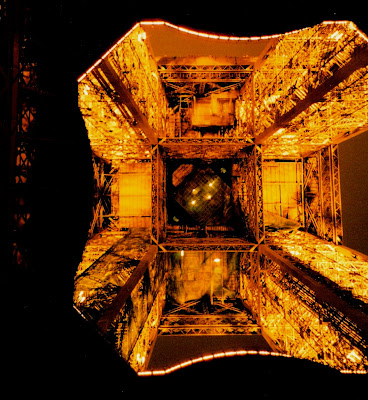
It had been only a year and a half, then, since my father had died, and in some ways, as I got to know Paris, I felt I was chasing his echo from decades before. He had, before meeting my mother, lived in Europe for several years, and I remember how he described his surprise at the size of the Eiffel Tower when he first went to Paris. He said he'd fully intended to go up it, but when he drove by the base, and realized the scale of the thing...well, he reconsidered...It's strange, as a young boy, to first learn of your father's phobias. Heights and enclosed-spaces--evidently, not my father's favorite combination. And so up the Eiffel Tower he never went!
Before he became ill and died, my father and I had begun having those conversations-over-coffee that make one finally realize, oh, here we are, face to face, adult to adult--still father and son, but no longer father and child...and as I would stop for a café-crème in one of Paris' innumerable cafés, I couldn't help but engage in internal soliloquies: what would I be saying to Dad right now, if he were here..

All this remembering of the past...

It reminds me of a passage from some of the writings of Rilke, the great German poet (1875-1926) and some of his musings on what it means to think and write--anything, not just poetry--about the past:

...Ah, poems amount to so little when you write them too early in your life. You ought to wait and gather sense and sweetness for a whole lifetime, and a long one if possible, and then, at the very end, you might perhaps be able to write ten good lines.

For poems are not, as people think, simply emotions (one has emotions early enough)--they are experiences.

For the sake of a single poem, you must see many cities, many people and Things, you must understand animals, must feel how birds fly, and know the gesture which small flowers make when they open in the morning.

You must be able to think back to streets in unknown neighborhoods, to unexpected encounters, and to partings you had long seen coming; to days of childhood whose mystery is still unexplained, to parents whom you had to hurt when they brought in a joy and you didn't pick it up (it was a joy meant for somebody else--); to childhood illnesses that began so strangely with so many profound and difficult transformations, to days in quiet, restrained rooms and to mornings by the sea, to the sea itself, to seas, to nights of travel that rushed along high overhead and went flying with all the stars,--and it is still not enough to be able to think of all that.

You must have memories of many nights of love, each one different from all the others, memories of women screaming in labor, and of light, pale, sleeping girls who have just given birth and are closing again.

But you must also have been beside the dying, must have sat beside the dead in the room with the open window and the scattered noises.

And it is not yet enough to have memories. You must be able to forget them when they are many, and you must have the immense patience to wait until they return.

For the memories themselves are not important. Only when they have changed into our very blood, into glance and gesture, and are nameless, no longer to be distinguished from ourselves--only then can it happen that in some very rare hour the first word of a poem arises in their midst and goes forth from them.

Wednesday, September 17, 2008

Tired but wired; bear with me...

Having a glass of milk late on a schoolnight...

...after an evening of stimulating conversation with some friends, I am trying to wind down...(Did you know that studies show that actively meeting and greeting people can affect the brain in a way similar to caffeine?)


A couple of nights ago, we came home to a desert full-moon, so I thought I would try the elbow-tripod method again while zooming; not professional, but not bad for a camera on a semi-automatic setting:


Only a few more days until the autumn equinox: the light is already noticeably different; here in Tucson I gauge it by how much of our front patio is in the shade in the afternoon. The sun is definitely lower in the sky. Although the thermometer is still in the upper 90's each afternoon, the angle of light makes everything look more like fall, although the mountains' lower slopes are still wearing a light coating of green from this summer's monsoon rains...

I found this diagram--the green path shows the path of the sun in Tucson on the summer solstice, the orange line is on the equinoxes, and the blue line is the winter solstice--and sunset and sunrise times, along with height in the sky are also indicated; handy, eh?

(click here for the website where you can get this sort of nerdy diagram for almost anywhere in the world.)

September. Ahh...

When I first moved to Seattle, in the late-summer light, clear over the Cascades--it was all so bright; the darkness of winter seemed impossibly far away...

A couple of years ago, when we moved back to the U.S. from Nicaragua, on one of those gorgeous September days in the Northwest that can make you almost forget the months of dreariness just about to descend upon everything, we went to Mt. Rainier for the day. (Now that I think about it, that was the last time I went to Mt. Rainier.) Here are some photos from that day:

--some fireweed by the highway that heads down to Yakima:

--Mt. Rainier, reflected in Upper Tipsoo Lake, on the Naches Loop trail:
--lake Dewey, east of Mt. Rainier:


Here in Tucson, no glaciated vistas at hand...but September is nice.
Evenings are ankle-bitten, due to the remaining few monsoon-mosquitoes buzzing around,
but the desert still has a few wildflowers, especially the remaining barrel-cactus blooms:


The other evening, we drove out to Saguaro National Park east; my wife wanted to see this 20-mile-loop route that I've been biking with a few other guys on Saturday mornings before sunrise...("Is it really real? does he really do that?" she's probably been thinking...)

And that's where we saw these blooms.

...from there you get a clear view of the entire Tucson basin, including looking south to the Santa Rita mountains, behind which lie the mile-high Sonoita grasslands that have become southern Arizona's 'wine country' in the past couple of decades...

=============

And to continue this tired-but-wired kick, (I am finally winding down; my pillow is beginning to call me), I found few more photos that I realize I hadn't posted.

Back in early June, I got a new camera. It's not quite a fancy digital SLR 'semi-pro', but it's in-between a point-and-shoot and the big-boys. It's plenty of machine for me, for now. It was a step-up from the 5-megapixel Canon I got in Guatemala back when we still lived in Central America. And on the first morning after I bought the camera, I woke up early and went to Sabino Canyon for a short hike to try it out. Here are a few photos from that morning:

--in the midst of the saguaros, one Parry's agave (more commonly called the "century plant;" it blooms once, spectacularly, and then the plant--usually a few decades old--dies):


--a desert mourning dove perched among saguaro blooms:


--the crazy fused arms of a cristate saguaro:


--zooming high, a bumblebee pollinating a saguaro bloom, 30 feet up in the air:


Finally. The glass of milk and photo-sorting have had their effect: to bed.

Bonne nuit, buenas noches, gute nacht.


Tuesday, September 09, 2008

Tonight with the camera...

...I'm up 'late' on a schoolnight, after a brief photo-expedition on our street.

A friend was over, and as we walked with her back to her car, I noticed an organ pipe cactus in bloom in front of a neighbor's house. These blooms come out only at night, lasting just until the morning of the following day--floral ephemera, the size of an outstretched hand, on view for 12 to 16 hours.

So, I went in the house and came back out with the camera, hoping that the flash wouldn't disturb the neighbors. It didn't look like anyone was home, so I didn't feel so bad hovering in front of their door...

And then, the moon caught my eye--about 3/4 full...I don't have any special lenses, or even a tripod, but I was able to use my elbows, leaning on the little wall in front of our yard, to stabilize the camera enough to get this:
(Excitement on this schoolnight: I've never been able to make out the lunar craters so clearly in a photo I've taken!)

=========================================

Two more weeks in the school-year have gone by. My efforts to develop a new habit have succeeded; I'm now a pre-sunrise, Mon-Wed-Fri jogger, as weird as that still seems to me...I've seen a couple of hawks on recent mornings, dozens and dozens of cottontail rabbits, and even a coyote...A nice way to clear the mind before dealing with the apparently natural propensity of teenage minds towards not learning verb conjugations.

I remind myself that the larger goal is to help students to become aware of and appreciate the wider world, among other things, to become more observant and detail-oriented as a consequence of having to deal with non-phonetic spelling and new grammatical patterns...and then the melody of Offenbach's cancan comes to mind, as my sneakers hit the asphalt--a 'cheap tool' to try and drill AVOIR ("to have" in French, an irregular conjugation: j'ai, tu as, il a, nous avons, vous avez, et ils ont) into pubescent skulls in a rythmical fashion.

It kind of works.

And then, right as I cool off, walking home, the sky begins to sprinkle on me. (The monsoon's not quite dead yet.) I look up--no clouds overhead! So weird...but off to the east, I see wispy moisture coming down...and borne on morning breezes, it ends up raining a mile or two away, diagonally:

September in Tucson, so far...