Sunday, July 27, 2008

a thirty-minute drive to see...

...a bug.

It's a Tucson tradition to drive out to the western edge of the city to watch the sun set from Gates Pass. You climb into the red rocks, past the neo-adobe palaces, curving between saguaro-studded crags, to end up looking west over pristine desert:

But while waiting for the sun to set behind the mountains, my eye caught this guy, about two inches long from antler-like antennae to bottom tip--some kind of beetle, I guess:

He (why not "she?") seemed to be admiring the evening light as well:

So, yes--a thirty minute drive, to end up seeing a bug.

It was a highlight.

And speaking of highlights...Go see Wall-E! (Click here for reviews.)Yes, the animated film about a boxy robot in the dystopian future. Poetic (yes, I wrote 'poetic') animation, allusions to classic science-fiction-films, the myth of Sisyphus, and the animated marvel of making a rusty box and even a roach (!) cute, an allegory of the dangers of too much ease and overconsumption--the film has it all. My wife and I were surprised at how much we enjoyed the film...it was even (whoa) thought-provoking.

...

And here's a thought-provoking expression: "nuke the fridge." Who out there has already heard it? It seems it's becoming a catch-phrase. Today's International Herald Tribune has an article: Indiana Jones and the temple of absurdly implausible excess.

And that's it for this Sunday night.


Tuesday, July 15, 2008

three weeks later...

It's been three weeks since I last wrote, during which time S. & I were in Maine, Québec City and Montréal...

...then we returned last week to a rainy desert and yesterday I burned my arms while going for a sunny-morning-bike-ride along the currently-flowing Rillito river. Local minutiae. That's what a blog is for, eh? (By the way, Paquito is on my shoulder and the patio temperature is 101 degrees as I type this.)

The east-coast jet-lag took surprisingly long to shake off; we felt sluggish for several days...

...after a truly relaxing stay with my aunt and uncle in Maine after having driven all over the heartland of French-speaking Canada.

Ahh, a summer afternoon in "Vacationland" (as Maine license plates officially proclaim): canoe, lake, and bugs...
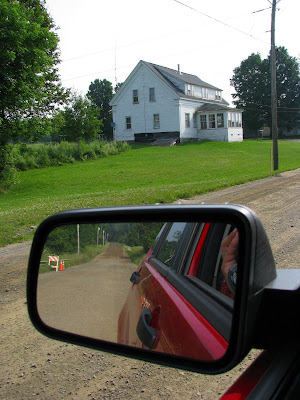
My aunt and uncle live on the shore of Lake Wassookeag in a 19th-century farmhouse that they've restored:

Just a few miles away is the old farmhouse (no longer in the family) where my father finished his growing up:

"Roots" of a sort, I guess...wistful to think what life was like back then...and how my father was the only one among his siblings who left New England...
===========

Two weeks prior to that, we flew into Portland late at night. We spent the next morning on the coast before driving inland up to Québec. The smell of the sea, evergreens, and wild roses was a heady change for our desert-acclimated nostrils...This lighthouse is perhaps the most-photographed lighthouse in the country, a visual cliché, even...How many of you have seen it without knowing where it is? Now you know where it is, the Portland Head Light, built in the 1790's.


Driving on up towards Canda, then...up the Kennebec River valley through Jackman to the Québec border...


When this road was opened up in the mid-19th-century, it became the main route for thousands of French-Canadians who were seeking work in the mills of New England. About a million people left, fleeing the rural poverty and unemployment of the time...In fact, their Franco-American descendents in the U.S. today total about 10 million, which is more than the current population of Québec (7.6 million)...kind of like how there are more "Irish" who live outside of Ireland than there are on the island itself...Anyway...Voilà--two demographic factoids for you...

=============

...The town of Baie-St-Paul, a couple of hours northeast of Québec City, on the north shore of the St.-Lawrence; artsy-but-not-too-fartsy, if you will..


...and nearby, further up the Charlevoix coast, is the island of l'Île-aux-coudres, which was linked to the mainland by year-round ferry only a few decades ago. It still feels like a different world...The notion of being cut off from the rest of civilization by ice for months at a time...no wonder the islanders were known for being self-sufficient...in the days before B-&-B's became weekend refuges for stressed-out city-dwellers...


...and Québec City...I fall easily into tourist-brochur-ese when talking about this place, so I will cease and desist...

Outside the old city's walls, the rue St.-Jean is an 'everyday' neighborhood that also happens to have the oldest grocery in North America (J.A. Moisan), right next to the quintessentially Québecois institution of the "dépanneur", the local equivalent of a 7-11 or Circle-K.

A chocolate-shop on the same street was really getting into the 400th-anniversary spirit with its window-display of one of the explorateur's ships...all for sail (oh, no, I didn't really just say that?) in chocolate, évidemment.

Perhaps I'm glorifying a vandal by posting this, but I thought this informal-stencil-art ("This is not graffiti") was clever:

...and onto Montréal, where we spent one morning in the Marché Jean-Talon, one of the largest urban farmer's markets left in North-America. The vendors are proud that there are no souvenir-shirts for sale among the scores of stands displaying fruits, vegetables, flowers, pastries, local cheeses, etc. etc...All smack-dab in the middle of the city's La Petite Italie neighborhood...

Yep, those are carrots up above. I overheard several passers-by asking, "what are those?" We're all so used to seeing the orange kind (peeled and in plastic) that most of us don't know that carrots naturally occur in a variety of shades and that the orange-roots became 'standard' only within the last century or so...Vive la différence, eh?

===========

We went up the Olympic Tower in the east end of the city for this view of some of the bridges over the St.-Lawrence:

...and just below the tower is the Chinese section of the Montréal Botanical Gardens...

The Tower was built for the 1976 Olympics; it's the tallest (almost 60-stories high) leaning structure in the world.

...Okay...I'm beginning to run out of captioning-steam...so let's try a cliché: "Montréal's streetscape is a beguiling mix of the old and the new, old world elegance and new world modernity." Yeah, I'm pretty sure that's lifted from some mediocre tourist-brochure...but, come on, the city is photogenic:


...driving back to Maine, through the region of the northern Appalachians called "The Eastern Townships," originally settled by English colonists who did not want to be part of a newly indepent United States of America. These Loyalists arrived in the 1790's, settling in places they named Sherbrooke, North Hatley, Cookshire, Mount Orford...But through the decades, the Catholic birthrate was so much higher than the Protestant that the region today is mostly French-speaking. (Historians call this "the revenge of the cradle," seriously...) So, New England scenery with a French accent--makes for a nice Sunday drive...
...and the last stop before crossing the border, at a casse-croûte, a road-side family-run alternative to corporate fast-food chains, French-Canadian artery-clogging charm.
The de rigueur highway snack is la poutine--crispy french fries topped with fresh cheddar cheese curds, with hot brown sauce (le gravy) poured over it all...the closest thing in the U.S., I guess, would be chili-cheese-fries...

Yep, that is the parting shot from Québec. Bon appétit & au revoir...

===========

So, back to Tucson and summer rain...flooded streets and clouds building over the mountains...

Tuesday, June 24, 2008

san juan/saint jean/solstice, hope of rain, nationalism

The twenty-fourth of June. For most of us, just another day...

Summer's a few days old now...

Here in Tucson a few clouds have begun to build up each afternoon, although the beginning of the monsoon is still a couple of weeks away. Until then, the days of 105 and higher keep piling up...

According to legend, on June 24th, 1540, the feast day of St John the Baptist in the Catholic calendar, Spanish explorer Francisco Vásquez de Coronado stood on the bank of a dry riverbed somewhere in Arizona and prayed for rain. And then the monsoon began. So, although the average beginning of the summer rains is July 7th, the 'traditional' beginning is associated with El Día de San Juan and it's even officially celebrated in the city of Tucson, a legacy of the Hispanic settlers...(click here for more info.)

Tomorrow, my wife and I are flying back east for a two-week stay in Québec and Maine.

(I won't lie--it will be nice to leave the oven for a couple of weeks...it's supposed to be in the 70's with occasional showers the entire time we're up there...)

Up there, today is known as "La Saint-Jean-Baptiste," or, more and more commonly, as "La fête nationale." Never mind that Québec is a province within the federal nation of Canada, whose official national holiday, "Canada Day," is on July 1st; le 24 juin is the party that begins summer for the one in five Canadians whose mother tongue is French. Instead of praying for rain, though, as in the Sonoran desert, the Catholics of the St.-Lawrence river valley probably used to pray for sun and a good growing season in the land where winter can last six months of the year...

I'm at home ironing this morning, getting ready to pack, so while ironing, I had the computer on, watching RDI, which is a Canadian French-language CNN of sorts...(if you want to watch it, streaming live, for yourself, here's the link.) And while I was ironing, coincidentally, a reportage came on, explaining how the 24th of June became Québec's provincial national holiday.

Here's a short version. (translated from the 'official' French: http://www.fetenationale.qc.ca/historique.html)

Go back a couple of millenia, to pre-christian Europe. The summer-solstice was a major pagan observance--
Stonehenge, bonfires, prayers to spirits for good crops, etc. etc...

The date eventually gets 'converted' by the medieval church to become the feast day for John the Baptist.

The first French settlers in the early 1600's bring the tradition, with bonfires, to the St.-Lawrence river valley.

In the 1830's, several decades after British governance, the idea comes up in Montreal to turn the 24th of June into a 'national' day of sorts, like St. Patrick's day had become for the Irish immigrants...

In 1908 Pope Pius X names St. John the Baptist the official patron saint for French-Canadians.

In the 1920's and the 1970's the day becomes an official 'day-off' for people in Québec, who during the 1960's adopted the moniker "Québecois" instead of "Canadien-français," and who went from being the most religious to the most secular society in North America.

For most people in Québec, then, today June 24th is like July 4th for people down in the U.S.

Some Anglo-Canadians find the term 'national' holiday abrasive, since it implies that Québec is a separate 'nation' from the rest of Canada. For a few radical Québecois, June 24th is indeed their day to promote nationalist separatism...but for most people in the province, it's a day off, with concerts, bonfires, fireworks...

...quite the evolution from pre-christian solstice celebrations...

...so, praying for rain down here in the desert, hoping for sun in the French-speaking north...
I just hope our luggage doesn't get lost tomorrow.
We're flying to Portland, Maine...from there we'll drive up to Québec city for several days...then to Montréal for several days...then to central Maine to visit some relatives before driving back to Portland for the flight back.


For me, Québec will always be 'my-first-trip-abroad-completely-on-my-own.'
My trips to visit relatives in Korea had always been, obviously, with family...the following year I would spend a summer in Switzerland, but this particular summer, after my sophomore year in college, I would have to see if I could truly be independently competent in a different language--my first 'immersion' in the language I'd been studying since the beginning of high school.

I flew up from Georgia to Montréal, the 2nd-biggest French-speaking city in the world outside of Paris, situated on an island with a 'mountain' in its midddle:
(view of downtown, from Mont-Royal park. The city caps its skyscrapers at about 45 stories, so that the buildings won't dwarf 'la montagne' that serves as its urban lung and playground)

From Montréal, I took the train to Québec city, arriving at its train station in pseudo-chateau style:
I arrived in the middle of a humid heat-wave; the entire city had all of its doors and windows open for several nights; "if the thieves want to come, let 'em come--it's too hot to close anything," the people said...No air-conditioning in this usually nordic city...and then a cold-front blew through and the temperature dropped almost 40 degrees.

Charles Dickens called the city, founded in 1608, "The Gibraltar of North America," perched on a cliff at the precise spot where the St.-Lawrence narrows from a veritable arm of the sea to a true river, controlling water-access to the interior of the continent. Whoever controlled Québec controlled North America. And so the British would fight the French for control of the spot. (During the War of 1812, the young U.S. wanted to gain control of the city as well.)

In 1759, after a century and a half of French rule, Québec finally fell to the British in a 20-minute battle on the Plains of Abraham. Canada would become British, but the language and religion of the settlers would be respected. And so Québec city remains a bastion for French-language culture in North America, and its Norman buildings within its walled old quarter make up a truly European enclave.

Forgive the tourist brochur-ese...but I'm excited about this trip; I've not been in 11 years, and I'm looking forward to introducing the place to my wife...

Perhaps a walk in the birch-forest on the north shore of the St.Lawrence...


...along with the Victorian architecture of central Montréal...

...We'll be back in Arizona on the 9th of July.

Wednesday, June 18, 2008

Back from L.A.--back in the blow-dryer again.

Summer breeze...what could be more relaxing, more welcoming?...a kiss of cool air on a sunny day--normally. But when it's 109 degrees, you don't want the breeze--it feels like a giant blow-dryer is blowing on you. Blowing, on the HOT setting. No respite.
We just got back a few days ago from a short trip to Los Angeles, and returning to Tucson after the comfortable Mediterraneanesque coast, clad in morning fog and 59 degrees--it's a hot and rude awakening. But you have to look at it with the detachment of a climatologist. 'One-hundred-nine degrees,' you say to yourself as you dry instantly upon stepping out of the warm pool, 'fascinating.' At least we don't live in Phoenix, where, as we drove through the other night on our way back, it was 110 degrees at 6:30 p.m! 'Even more fascinating.'

Los Angeles. Like many people, I have a love-hate relationship with the place--so easy to deride the botox-mentality, the pollution, the foolishness of building a megalopolis on the San Andreas fault with no natural water supply nearby, the paparazzi, the racism...but the weather, oh the weather and the vegetation that it creates. And the museums. And the food. The craziness is fascinating. Glad to visit; wouldn't want to live there.

This was a last-minute trip, made possible by my being off for the summer and my wife's work-schedule. Some friends of ours from Guatemala and Nicaragua were in L.A. for a quick stay, and we thought--when might we see them again without having to fly down to Central America? An 8-hour drive across the desert is much cheaper than plane tickets...even with gas at $4.80/gal in California. And so we went.

Some highlights.

I have to start with a bit of kitsch--a very refined sense of Angeleno kitch:
Yes, you're not imagining it--those are multiple copies of Michelangelo's David 'adorning' the front yard of a house not too far south of the Hollywood sign. Perhaps a frontal view of the property might do it more justice:

The house is a minor landmark in the otherwise lovely Hancock Park neighborhood. Note the subtle fleur-de-lis on the fence. Royal taste, indeed.

Interestingly, the house was formerly the home of Nat King Cole. The 17 copies of David are the work of the current owner, who has dubbed his property "Youngwood Court." In December, the Davids wear red caps. The neighborhood, (where we stayed, incidentally,) is full of lovely 1920's buildings on sycamore-lined streets where well-heeled Jewish families make up the majority of pedestrians on a Saturday...I wonder what they think of this appropriation of one of history's most famous Jews...Oy vey, tacky...
=============
Still sticking with white architecture, now let's climb up into the foothills of the Santa Monica mountains and see real art--the Getty Center, L.A.'s answer to The Louvre...and it's free. You leave your car at a parking lot in a valley next to the 405-freeway, and you 'rise above it all' to the travertine-art-city-in-the-sky on a specially built tram that whisks you quietly up the mountain:

The views inside and from the museum complex are stupendous, with lovely gardens as well...Look, an urban vineyard! And jacaranda trees! This is the part of L.A. that makes you say, ahh, isn't it beautiful, instead of the usual, eww, isn't this gross...or whoa is that gaudy...

So that's an overview of the Getty Center, built in the 1990's...The original Getty Villa is a few miles away, in a secluded Malibu canyon overlooking the Pacific:
Decades ago, oil billionaire J. Paul Getty decided to construct a replica of an excavated Roman villa that had been buried by the eruption of Vesuvius in 70 A.D., and then to fill it with his increasing collection of art. Later, it was open to the public, and eventually the new Getty center was built to house most of the art dating from the Middle Ages up to the 20th century. This left the old villa to house exclusively the Greek, Etruscan and Roman Antiquities collection, in an 'authentic' setting. Impossibly picturesque, with ocean breezes and the Mediterranean garden setting...


I haven't even begun to mention the sculpture, painting, etc. etc. inside these two Getty museums. Click the link and visit the websites...and better yet, next time you're in L.A., GO! It's free!!

==========================

On to modern things, then. Or, rather, 'postmodern.'
The new home of the L.A. Philharmonic is the Frank Gehry-designed Walt Disney Concert Hall:

I'm impressed, but I'm not sure if I like it...I mean, are all the curves there merely to impress? Is it just a bunch of metallically curvaceous virtuosity for virtuosity's sake?
(I do like it better, though, than Gehry's multiculored 'blob' at the foot of the Space Needle in Seattle, his "
Experience Music Project.")

Our visit to L.A. was not all architecture, though....Our whole point in going was to spend some time with our friends...which inevitably involved eating, of course. I introduced my wife to "The Cuban Chicken" at the oddly-named "Versailles" restaurant, which is an L.A. institution. One word: AJO.

And, a bit of culinary nostalgia--my first introduction to Thai food, as a young teenager visiting L.A. from Georgia (what's "tie" food?) en route to visit relatives in Seoul, was at a place in Koreatown called Ocha. We revisited it...It is always packed...with Latinos. Our table and the wait-staff were the only non-Hispanics in the place...in Koreatown...Only in L.A. El pad thai es muy rico; pruébalo pues!

============

The surreality of L.A., which is what makes the place so re-visit-able (?) was summed up well, I thought, in a column in this past Saturday's Los Angeles Times, which we read while sitting in a bakery/café on Beverly Blvd. I'm taking it upon myself to copy the text here. Well worth the read...

Native sons and daughters

Raise your kids in L.A., and they'll never want a spray-on tan.

By Chris Ayres

As he made the fateful journey from womb to delivery ward, I like to think my son gave a moment of thought as to what would greet him on the other side. Would he find himself in an igloo, surrounded by Eskimo obstetricians? In a mud hut in an African township? In a bombed-out suburb of greater Baghdad? Whatever he was expecting, it must surely have come as an immense relief to glimpse the masked face of Dr. Jason Rothbart -- the ob-gyn from People magazine! -- and the bridge-of-the-Enterprise interior of Cedars-Sinai Medical Center, a palm-tree-shaded stroll from Rodeo Drive. No wonder the little fella shouted and waved his arms so much. "Jackpot!" he was probably telling us. "I've hit the jackpot!"

No one else seemed to share his excitement. "Now that you're a father, I imagine you'll be leaving L.A.," said a colleague a few days later. Confused, I asked him what on Earth he meant. "Oh, y'know," he said, in a prickly tone. "You don't want your boy exposed to 'Hollywood values,' do you?"

In all fairness, this was the opinion of a man with a famously conservative disposition. Nevertheless, it was repeated to me over the following weeks by several less-likely candidates, including a rock musician with a history of life-threateningly unwise lifestyle choices. She informed me that gay friends of hers had just adopted a boy but had decided to relocate to Scandinavia. I asked why. "Oh, y'know -- all this," she said, pointing to the L.A. cityscape beyond the diner in which we were sitting.

At first I shrugged off these comments, but as my first-ever Father's Day approached, I began to wonder if they were right. Maybe L.A. really is the worst possible environment to raise an enlightened young man of the 21st century.

Take my own journey to this city. Raised in a sheep-farming village under the rain-swollen skies of northern England, I spent much of my boyhood fantasizing about the promised excesses of Southern California: the hot skies, the hot cars, the even hotter women. Naturally, when I finally made it here at the age of 27, I indulged. I made walking-distance journeys in a 9-mpg SUV; I bought spray-on tans and caviar facial spa treatments; I purchased a negative-amortization, adjustable-rate mortgage via speakerphone from a broker in Santa Monica. The only thing that saved me from an implosion of Britneyesque proportions was the thought of my father, in flat cap and tweed jacket, shaking his head in sadness and bewilderment. But how would my own son survive if L.A. was all he knew?

Terrified at the damage I was about to inflict, I began to plot a relocation, to an eco-village in the Netherlands, perhaps, where the locals would commute in giant wooden clogs and make electricity from flatulence induced by homemade cheese. My boy would learn the value of abstention, worthiness and lackluster personal hygiene. My friends seemed to think this was an excellent idea, aside from one surprising constituency: those who were actually brought up in L.A.

What are you thinking? they exclaimed. Kids in L.A. get to go outdoors all year round. They have mountains, ocean, desert. They have culture. They have world-renowned educational establishments.

An epiphany soon followed. Being raised in L.A. isn't a problem. It's not being raised in L.A. that's a problem. It's being raised in a sheep-farming village that's a problem. Without exception, my native Angeleno friends are utterly immune to the lure of "the L.A. lifestyle." They drive tediously fuel-efficient cars. They have fixed-rate mortgages. They find Sunset Plaza to be an unbearable enclave of poseurs and Euro-cheese. Indeed, a childhood in L.A. seems to act like a kind of vaccination against the media-image of this city sold to and consumed with great pleasure by the rest of the world.

And so, on my first Father's Day, I can say with absolute confidence that I am no longer troubled by those who question my decision to raise my son in L.A. Soon, he will be a proud Angeleno: He will look at me with contempt as I cast admiring glances at shirtless Lamborghini drivers cockscrewing up Sunset Plaza Drive; he will never shop at Kitson; he will be unimpressed that the $16 gravlax-filled bagels at Barney Greengrass in Beverly Hills are flown in daily from New York. And perhaps one day, when he's older, he'll move to the English countryside, where he'll adopt a fake Madonna-style accent and buy a lordship on the Internet.

And then, of course, he'll have his own son, who'll get bored and come to L.A. to see his grandfather -- he won't have aged -- and together they'll go to the Sky Bar and drink $1,000 martinis.

Chris Ayres is a columnist for the Times of London and the author of "War Reporting for Cowards" and the forthcoming "Death by Leisure: A Cautionary Tale."

Saturday, June 07, 2008

Cactus-sunrise on bike...to double decker Anglophile coffee

I'd given my word, so I woke up at 4:40 (voluntarily!) this morning
in order to meet a group of friends before sunrise (about 5:20 a.m.)
in a parking lot on the eastern edge of the city
to then go biking to and through Saguaro National Park and back.

I survived! And I even want more...
Sunrise over the Rincon mountains,
'cold' morning air as we dipped into dry washes
where the cool air had pooled into pockets of 60-degrees...
(nice, knowing that the afternoon will be 40 degrees warmer)...
seeing lizards and cottontail rabbits dart acrosss the road...
sweet mesquite-perfumed spots
and views across the entire
Tucson basin, down to the Santa Ritas,
across toward the Tohono O'odham Nation,
over to the Santa Catalinas,
the long mountain shadows still reaching westward...

A new Saturday-a.m. routine has been born, I believe.
I did lag behind some of the more seasoned spandex-clad cyclists...
but hey, it was my first time...
I didn't do the entire up-and-down loop within the park;
I stayed with a couple of the riders and did the shorter 'picnic' loop;
gotta work up to the full thigh-busting route...
I am glad I drove the route a few days ago, so I knew what I was getting myself into...

We were done by seven, so on the way home, I thought I'd stop for another coffee (the 4:30 a.m. coffee had worn off)--and what better place to do so, than this non-Starbucks establishment:

Yes, the Bristol Coffee Bus. An actual red, British double-decker from the mid-20th century, shipped over to this side of the pond years ago, now serving as a brilliant stationary caffeination stop. (and they serve PG tips if you want an 'authentic cuppa' cha...) It's not on my usual commute-route, so I'd never stopped in...so now, after nearly a year of living here, after my first bike-ride with the 'big boys,' I thought I should check it out.

(Arizona also has, in case you weren't aware, the original "London Bridge", shipped and rebuilt, stone by stone, on the western edge of the state. Desert anglophiles, I guess...)

I told the barista I'd been wanting to stop at the place for nearly a year since moving here; then the owner, working behind him, asked me--"where'd you move from?"--to which I replied "Seattle." Pause. "You'd better make him a good one!" said the owner to the employee. I guess Seattlites do have that rep-brew-tation.

(Egad. Such a horrible forced pun, yet I couldn't help myself. The caffeine and the post-bike-ride endorphins have gone to my head. Please forgive.)

The paper-reading view from the top deck, across a nondescript parking lot, north to the mountains:
So, a year, later, I'm still loving Tucson; some choice imports, irritatingly quirky at times, but the setting is glorious.